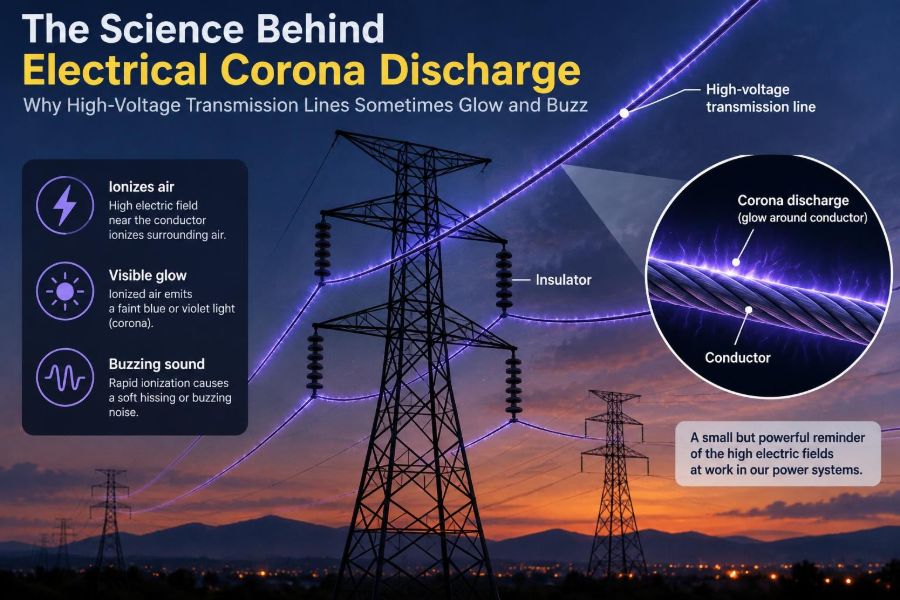

On a humid evening, a high-voltage transmission line can seem strangely alive. You may hear a faint crackle or buzz above the road, and in darkness, a pale violet-blue haze may appear around fittings or conductor edges.
That effect is not electricity “leaking” in the ordinary sense. It is a localized interaction between a very strong electric field and the surrounding air—a phenomenon called corona discharge.
Corona matters because it costs power, creates audible noise and radio interference, and influences how transmission lines, substations, and high-voltage equipment are designed. It also provides engineers with a useful warning that electric-field stress is becoming concentrated somewhere it should not be.
The glow and buzz are therefore more than visual curiosities. They are visible and audible clues to the physics governing insulation, voltage, geometry, weather, and reliability on the grid.
⚡ What Corona Discharge Actually Is
Corona discharge is a partial electrical discharge in a gas, usually air, surrounding a high-voltage conductor. The gas near the conductor becomes partially ionized: some molecules lose electrons, creating free electrons and positively charged ions.
Unlike a solid metallic connection, this ionized region does not normally form a complete conducting path between two energized parts. Current flows locally through the air around the conductor, rather than continuously bridging the entire insulation gap.
This distinction is central. Corona is an incomplete breakdown of the insulation medium, while an arc is usually a far more conductive, sustained path between points at different voltage.
🌬️ Why Air Usually Behaves as an Insulator
Dry air contains molecules whose electrons are normally bound to their atoms or molecules. At ordinary electric-field levels, air resists charge movement and works as an effective electrical insulator.
Apply a sufficiently intense electric field, however, and electrons can gain enough energy between collisions to knock electrons free from other air molecules. This begins ionization.
The threshold is not a single universal voltage. It depends on the local electric-field strength, air density, humidity, surface condition, conductor shape, and the size of the stressed air region.
🔬 Electric Field: The Hidden Driver
Voltage is the difference in electric potential between two points. An electric field describes how strongly that voltage acts over distance and how much force it exerts on a charge at a particular location.
A line may operate at hundreds of kilovolts, but corona does not arise simply because the number on the nameplate is large. It arises where the local field at a surface becomes high enough to ionize nearby air.
This is why geometry matters so much. The same system voltage can produce modest fields around a smooth, large-radius conductor and extreme fields near a sharp protrusion.
📍 Why Sharp Points Trigger Corona First
Electric charge tends to crowd at regions with a small radius of curvature. A needle tip, burr, damaged strand, sharp bolt edge, or pointed hardware feature concentrates the electric field into a very small area.
A useful analogy is water pressure at the nozzle of a hose. The amount of water in the system may be unchanged, but narrowing the outlet produces a more intense local jet. In electrical systems, a sharp feature concentrates field rather than water flow.
Engineers avoid unnecessary sharp edges on energized hardware for this reason. Smooth, rounded surfaces distribute the field more evenly and increase the voltage at which corona begins.
🧪 The Ionization Avalanche
Once a few free electrons are present near a highly stressed surface, the electric field accelerates them. As they collide with air molecules, they can create additional electrons and ions.
This multiplication process is often called an electron avalanche. It is not necessarily continuous or uniform; it may occur as many tiny, rapidly repeating discharge events in the air close to the conductor.
Positive ions move more slowly than electrons and can form a space-charge region near the surface. That charge alters the local field, making corona a dynamic process rather than a simple on-off switch.
💜 Why the Glow Is Often Blue or Violet
Excited molecules do not always ionize. Some absorb energy and later release it as light when their electrons return to lower-energy states. Nitrogen in air contributes strongly to the blue-violet appearance often associated with corona.
The light is usually faint because the active region is small and the energy involved is spread among countless microscopic events. Darkness, fog, and rain can make it easier to notice.
Color alone is not a diagnostic instrument. Viewing conditions, camera sensors, materials, and other discharge mechanisms can change what an observer sees. Still, a soft violet halo around a high-field feature is a familiar corona signature.
🔊 Where the Buzzing and Hissing Come From
Corona produces sound because ionization events create tiny, rapid pressure disturbances in the surrounding air. Many small discharges occurring repeatedly can combine into a hiss, crackle, or 100/120 Hz-related buzz near alternating-current equipment.
On overhead lines, noise can become more noticeable during rain, fog, or snow. Water droplets distort the electric field and form numerous high-stress points on the conductor surface.
Sound level depends on line voltage, conductor design, weather, distance, terrain, and background noise. A faint sound near a major transmission corridor may be expected; a new or sharply localized sound at equipment can justify inspection.
🌩️ Corona Is Not an Arc Flash
Corona, sparking, arcing, and arc flash are related to electrical breakdown but are not interchangeable terms. Confusing them can lead to poor risk assessment.
| Phenomenon | Typical path | General behavior |
|---|---|---|
| Corona discharge | Localized ionized air near a surface | Partial discharge; may glow, hiss, and cause gradual losses |
| Spark | Brief path across a gap | Short-duration breakdown, often visible and impulsive |
| Arc | Conductive plasma path between points | Sustained high-current discharge capable of intense heating |
| Arc flash | Arc event in electrical equipment | Hazardous release of heat, light, pressure, and molten material |
Corona can sometimes develop into a more serious discharge if conditions deteriorate, but its normal operating form is not the same as a fault arc. The response must match the actual equipment condition and voltage environment.
📈 The Corona Inception Voltage
The corona inception voltage is the voltage at which corona begins under specified conditions. It is not a fixed property of a wire alone; it belongs to the entire arrangement of conductor, surroundings, air conditions, and surface state.
For alternating-current systems, corona may start near voltage peaks because instantaneous field strength rises and falls every cycle. A line can therefore show intermittent discharge behavior close to its inception threshold.
Once corona has started, it may persist down to a somewhat lower voltage than the level that first initiated it. This difference between starting and extinguishing conditions is associated with the changing ion population around the conductor.
📏 Conductor Diameter Changes the Field
For a given voltage and spacing, increasing conductor diameter generally reduces surface electric-field intensity. A larger radius spreads charge over a broader surface.
This is one reason extra-high-voltage lines often use large conductors or multiple conductors per phase. The choice is not solely about carrying current; it also helps control electric-field stress, corona loss, and audible noise.
A thicker conductor is not automatically the best answer. It costs more, weighs more, affects mechanical design, and changes wind and ice loading. Transmission design balances electrical, thermal, mechanical, environmental, and economic constraints.
🧵 Why Bundled Conductors Are Used
A bundled conductor uses two or more sub-conductors separated by spacers to make one electrical phase. From the perspective of the surrounding electric field, the bundle behaves like a conductor with a larger effective diameter.
That reduces field concentration at each individual sub-conductor and can reduce corona-related effects. Bundles also influence line inductance and capacitance, which matters for the transmission of large amounts of power over long distances.
The spacers themselves need careful design. Their shape, fittings, and condition must avoid creating localized high-field points that undermine the benefits of the bundle.
🌧️ Weather Can Make Corona More Noticeable
Rain does not necessarily mean a transmission line is failing. Drops on a conductor create irregular shapes and pointed water features, locally raising the field and encouraging corona.
Fog, mist, snow, contamination, and icing can also alter the effective surface. Wet or dirty insulators may develop surface leakage currents, which are related to but distinct from corona around a bare conductor.
Atmospheric pressure and temperature matter because they influence air density. At high elevations, lower-density air generally provides fewer molecules in a given volume, changing breakdown behavior and requiring appropriate insulation coordination.
🌫️ Altitude and Air Density
Equipment that operates acceptably near sea level may need different clearances or ratings at elevation. Lower air density changes the conditions under which ionization can begin and propagate.
Designers account for this through standards, tested equipment ratings, and site-specific calculations. It would be unsafe to take a rule of thumb from one climate or altitude and apply it unchanged everywhere.
Temperature, barometric pressure, and humidity fluctuate daily. For that reason, corona observations made in the field should be interpreted alongside weather conditions rather than treated as isolated evidence.
📡 Radio Interference and Electromagnetic Noise
Corona consists of fast electrical events, and fast changes in current can produce electromagnetic interference. Historically, this could be heard as interference on radio receivers near high-voltage lines.
Modern communications systems use different bands and technologies, but electromagnetic compatibility remains an engineering concern. Utilities assess line designs and equipment so that unwanted emissions remain controlled in the intended operating environment.
Interference is not caused by every faint hum. Many devices emit electromagnetic noise, and diagnosis requires appropriate instruments, frequency awareness, and knowledge of the nearby electrical infrastructure.
🔋 Corona Loss: Energy Leaving the System
Energy is required to ionize air, move charge, produce light, make sound, and heat the gas. This becomes corona loss—a real, though design-dependent, power loss on a high-voltage system.
The loss rises when field stress is higher and often becomes worse in unfavorable weather. For large transmission networks, even relatively small losses per unit length can matter over extensive routes.
Corona loss is not usually calculated by one simple universal equation in practical design. Engineers use validated models, conductor geometry, weather assumptions, and sometimes testing to estimate performance for a specific line.
🏗️ Why Transmission Voltage Still Goes Up
Higher voltage can increase the risk of corona if conductor geometry is not adjusted. Yet high voltage is essential for efficient bulk power transmission because the same power can be delivered with lower current.
Lower current reduces resistive heating losses, which scale with the square of current. The engineering goal is therefore not to avoid high voltage; it is to manage the electric fields that high voltage creates.
Bundled conductors, phase spacing, shield rings, smooth fittings, and proper insulation design allow utilities to realize the advantages of high-voltage transmission while controlling undesirable discharge effects.
🛞 Corona Rings and Field Grading
Large rounded metal rings seen around bushings, insulator strings, and terminations are often called corona rings or grading rings. Their purpose is to reshape the electric field around high-voltage hardware.
Without a ring, the field may crowd at the end fitting, where metal edges, insulator interfaces, and nearby grounded structures create a complex geometry. A properly positioned ring reduces peak stress and moves the highest-field region away from vulnerable surfaces.
Ring size and placement are engineering decisions, not decorative additions. An incorrectly selected or damaged ring can fail to provide the intended field control.
🧱 Insulators Face a Different Challenge
Insulators support energized conductors while separating them from grounded towers or structures. Their surfaces must withstand electrical stress, weather, contamination, and mechanical loads.
Corona near metal end fittings can degrade materials over time, while surface contamination combined with moisture can lead to leakage current and, in severe cases, flashover. Flashover means the insulating path across a surface or through air has broken down sufficiently to create a more complete current path.
Long strings, sheds, grading devices, cleaning strategies, and material choices help manage these risks. The optimal approach varies with pollution level, coastal salt exposure, desert dust, industrial emissions, and rainfall patterns.
🧰 Common Places Corona Appears
Corona is associated with overhead transmission lines, but it can occur in many high-voltage systems whenever local field stress becomes excessive.
- Damaged strands, clamps, and connectors on overhead conductors
- Transformer bushings and cable terminations
- Switchgear, disconnect switches, and instrument transformers
- High-voltage laboratory electrodes and test fixtures
- Particle contamination or sharp defects inside gas-insulated equipment
- High-voltage DC systems, where ion movement and field behavior differ from AC systems
The location changes the diagnostic approach. Accessible outdoor hardware can be visually inspected, while enclosed equipment may require specialized electrical testing.
🕵️ Detecting Corona Before Damage Grows
Corona is often treated as a form of partial discharge, although the term partial discharge also includes internal and surface discharges within insulation systems. Detection helps maintenance teams locate abnormal field concentrations before they become failures.
Common techniques include ultraviolet imaging, acoustic or ultrasonic sensing, radio-frequency detection, and electrical partial-discharge measurements. Each method has strengths and limitations depending on the equipment, background noise, access, and discharge type.
Ultraviolet cameras can reveal emissions not easily visible to the human eye. They are useful for locating outdoor corona, but image interpretation still requires trained personnel and appropriate inspection conditions.
🎧 Why Ultrasound Helps Inspectors
Many corona events generate ultrasonic sound above the normal range of human hearing. Handheld detectors can convert this energy into audible signals or visual indicators, helping inspectors narrow down a source.
Ultrasound is especially useful when a discharge is too small to see clearly in daylight. It can also help distinguish a localized source from the general background sound of wind or traffic.
However, ultrasound does not identify every defect by itself. Reflections, wind, competing mechanical noise, and distance can affect results, so findings are normally combined with visual inspection and electrical evidence.
🧭 Reading a Field Observation Carefully
Suppose an inspector detects a strong localized ultraviolet emission at one clamp on a dry day, while comparable clamps are quiet. That hypothetical pattern could suggest a rough surface, loose connection, damaged hardware, or geometry issue needing closer examination.
By contrast, a broadly distributed increase in noise during heavy rain may reflect expected weather-related corona across the line rather than a single defective component. The practical question is whether the observation is localized, persistent, changing, or correlated with abnormal heating or damage.
Trend information is valuable. A new signal or a signal that intensifies over repeated inspections is often more informative than one isolated measurement.
🔥 Material Degradation and Ozone
Corona can produce chemically reactive species, including ozone and nitrogen oxides, as air molecules are energized and recombine. In open air, these products disperse, but in enclosed spaces or near sensitive materials they can contribute to aging concerns.
Persistent discharge may erode polymeric insulation, attack coatings, or leave deposits depending on the environment and materials involved. The severity depends on discharge energy, duration, ventilation, humidity, and the material’s resistance to chemical and electrical stress.
This is why a small discharge should not be dismissed merely because it is not yet causing an outage. Long-term deterioration can be as consequential as an immediate fault.
⚠️ Public Safety Near High-Voltage Lines
A buzzing or glowing line should never be approached, touched, or investigated by the public. The greatest danger near electrical infrastructure is not necessarily corona itself, but the possibility of energized equipment, fallen conductors, damaged insulation, or step-and-touch voltage hazards.
If a line appears damaged, is arcing, has fallen, or is making unusual severe noise, stay well away and contact the utility or emergency services as appropriate for the location. Keep others away as well.
Do not throw objects at lines, use long tools near them, fly drones close to them, or attempt to photograph equipment from within restricted areas. Only qualified personnel should assess high-voltage assets.
👷 Safe Practice for Electrical Workers
Qualified workers address suspected corona within established utility or facility procedures. These commonly include hazard assessment, access control, appropriate approach distances, approved test equipment, and verification of equipment condition before hands-on work.
Corona testing is not a substitute for electrical safety rules. A detector can identify a possible source, but it does not make an energized installation safe to touch or eliminate the need for arc-flash and shock protection planning.
Equipment-specific instructions, local regulations, and employer procedures govern the work. Conditions at a transmission tower, substation, and indoor switchgear lineup can be very different.
🛠️ Design Choices That Reduce Corona
Effective corona control begins during design, not after a line starts humming. Engineers seek to keep peak surface fields below acceptable levels for expected operating and weather conditions.
- Use adequate conductor diameter or bundled conductors at high voltage.
- Maintain suitable phase-to-phase and phase-to-ground clearances.
- Specify smooth fittings and avoid burrs, sharp edges, and abrupt geometry changes.
- Apply grading rings and shields where field calculations show high stress.
- Select insulation profiles and materials for local contamination and climate.
- Inspect hardware, connectors, and conductor surfaces throughout service life.
These measures reduce rather than magically eliminate all corona. Some weather-dependent activity may still occur on very high-voltage lines, so the design target is controlled, acceptable performance.
🧼 Maintenance: Smooth Surfaces Matter
Loose hardware, corrosion, damaged conductor strands, contamination, and deteriorated fittings can all create new high-field sites. Routine inspection therefore supports both reliability and corona control.
Maintenance may involve replacing defective fittings, correcting conductor damage, cleaning or washing insulators where contamination is severe, and confirming that shielding and grading hardware are intact. The right intervention follows diagnosis; blindly replacing parts can waste time and miss the actual cause.
After a repair, follow-up inspection can verify whether the discharge signature has disappeared or been reduced as expected.
❌ Common Misconceptions About Corona
One misconception is that any visible glow means an imminent catastrophic failure. A faint corona effect can occur on properly designed high-voltage equipment under certain conditions, particularly in wet weather.
The opposite mistake is assuming every buzz is harmless. New, localized, dry-weather, or rapidly worsening corona can point to a defect requiring engineering attention.
Another misconception is that voltage alone predicts corona. In reality, local electric-field intensity—shaped by voltage, geometry, surface condition, and atmosphere—is the deciding physical factor.
🔄 AC and DC Corona Behave Differently
Both AC and DC systems can produce corona, but their charge behavior differs. In AC, the polarity reverses repeatedly, while in DC, ions can move in one prevailing direction and establish a more persistent space-charge distribution.
These differences affect audible noise, ion flow, radio interference, and how fields develop around conductors. They are among the reasons high-voltage DC transmission requires its own detailed design and testing methods.
It is risky to transfer a rule from AC equipment directly to DC equipment without checking the relevant standards, geometry, polarity, and environmental assumptions.
🧠 A Practical Mental Model
Think of corona as air being pushed just beyond its insulating comfort zone at a specific location. The system voltage supplies the driving force, but a sharp point, droplet, defect, or cramped geometry creates the local stress concentration.
If that intense local field gives electrons enough energy to start repeated ionization, the air becomes weakly conductive in a small region. Light, sound, electromagnetic noise, chemical by-products, and energy loss are the observable consequences.
This mental model explains why engineers enlarge, smooth, space, shield, clean, and inspect high-voltage components. Each action either lowers the local field or removes the surface feature that concentrates it.
✅ The Core Takeaway: Control the Local Field
Corona discharge is neither mysterious nor merely cosmetic. It is a physical response of air to high local electric-field stress, commonly revealed by a faint glow, hiss, ozone-like odor, radio noise, or instrument reading.
For power systems, the objective is not simply “use less voltage.” High voltage enables efficient long-distance transmission. The objective is to use appropriate geometry, insulation, field grading, and maintenance so that no small region is forced into unwanted ionization.
When a line glows or buzzes, the underlying lesson is precise: electrical systems are governed not just by total voltage, but by how that voltage shapes the electric field around every conductor and fitting.
Corona is the visible and audible reminder that high-voltage engineering succeeds by controlling electric fields where they are most concentrated. ⚡🔬🌬️