
A transformer can sit quietly beside a factory, beneath an office building, or at the edge of a neighborhood for decades. From the outside, it may appear unchanged: the tank is intact, the gauges look normal, and power continues to flow.
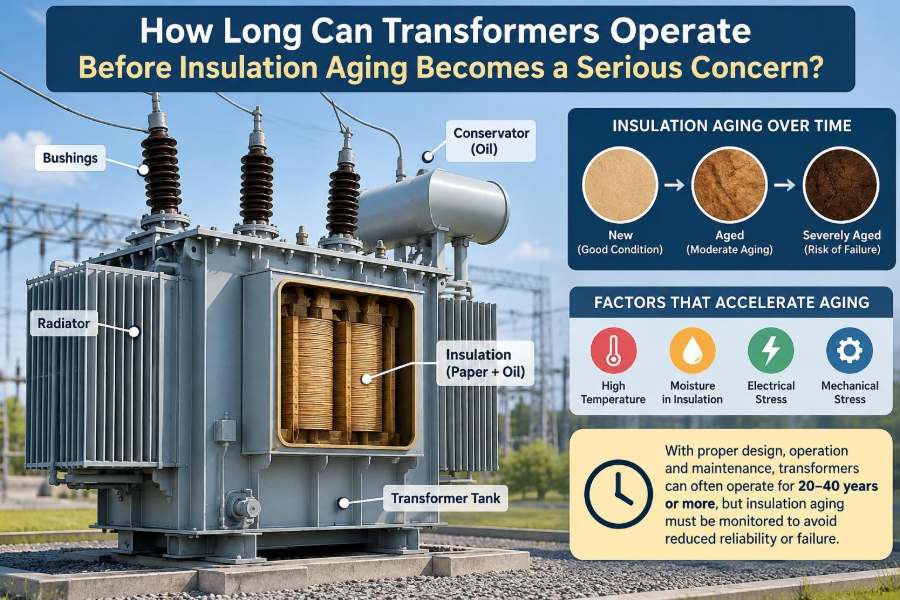
Inside, however, its most life-limiting material is gradually changing. Paper insulation and insulating oil are exposed to heat, oxygen, moisture, electrical stress, and mechanical forces every time the transformer operates.
This raises a practical question for asset owners and engineers: when does normal aging become a serious reliability concern? The answer is not a single calendar age. A well-managed transformer can remain dependable long after its nominal design life, while a poorly cooled or moisture-contaminated unit can lose substantial insulation life much earlier.
Understanding insulation aging helps students connect thermal theory to real equipment, and helps working professionals make better choices about loading, monitoring, maintenance, and replacement.
⚙️ The short answer: age alone does not decide
Transformers are often designed around an expected service life measured in decades, but this is a planning basis rather than an expiry date. The condition of the insulation system matters far more than the number on the nameplate or the installation date.
Insulation aging becomes serious when its strength and mechanical integrity have fallen enough that a fault, short circuit, overload, or switching event is more likely to cause irreversible damage. A transformer may still operate normally at that point, which is why condition assessment matters.
🧱 Why insulation determines transformer life
The windings contain energized conductors packed closely together. Insulation keeps turns, windings, the core, tank, and grounded structures electrically separated. It must also withstand mechanical movement during faults and preserve cooling passages.
In many oil-filled power transformers, cellulose paper or pressboard around the conductors is the life-limiting insulation. Oil can be filtered, dried, reclaimed, or replaced. Winding paper cannot be practically renewed without opening and rebuilding the active part.
📦 What is inside an oil-filled insulation system?
Mineral oil or another insulating liquid performs two jobs: it transfers heat away from windings and provides dielectric strength, meaning resistance to electrical breakdown. Solid cellulose insulation provides the close-contact separation and mechanical support that liquid alone cannot provide.
These materials age together. Degraded oil can contain water, acids, particles, and reactive compounds that accelerate paper aging. Aged paper can release moisture and degradation products into the oil.
🧬 Cellulose depolymerization: the hidden change
Cellulose is made of long molecular chains. Heat, water, oxygen, and acids gradually break these chains into shorter lengths, a process called depolymerization. The paper may retain acceptable dielectric behavior for a time while becoming mechanically weak.
This distinction is crucial. A weak winding insulation structure may fail during a through-fault because electromagnetic forces move the conductors, even if routine electrical tests did not indicate an immediate dielectric breakdown risk.
🌡️ Temperature is the dominant aging driver
Thermal aging is usually the main long-term driver of insulation loss. Chemical reactions generally speed up as temperature rises, so a transformer that repeatedly operates hot consumes insulation life faster than one operating at moderate temperatures.
The critical temperature is not simply ambient air temperature or top-oil temperature. It is the winding hot-spot temperature: the hottest location within the winding insulation. This point is often estimated from load, oil temperature, cooling condition, and transformer thermal characteristics.
🔥 Why overloads are not all equally harmful
A short overload on a cold day may be acceptable if the transformer’s loading guide, thermal model, and cooling equipment support it. A similar overload during high ambient temperature, with blocked radiators or a failed fan, can produce a much higher hot spot.
Duration matters too. Insulation has thermal inertia: temperatures take time to rise and fall. Repeated daily peaks can produce more aging than a single rare event, particularly when the unit has little time to cool between peaks.
🌬️ Ambient temperature and cooling margin
High ambient temperature reduces the transformer’s ability to reject heat. Dirt on radiator fins, restricted airflow, failed pumps, inactive fans, low oil level, or poor control settings can further reduce cooling margin.
A useful operational lesson is that loading limits are conditional. The same megawatt load is not equally stressful in every season, at every site, or in every cooling mode.
💧 Moisture is more than an oil-quality issue
Water in oil attracts attention because it lowers dielectric strength and can contribute to discharge risk. Yet moisture in the paper is often more consequential for long-term life because it accelerates cellulose breakdown.
Water moves between paper and oil as temperature changes. Sampling oil when the transformer is hot or cold can therefore show different moisture levels without a true change in total water content. Interpreting results requires temperature, load, and insulation equilibrium to be considered.
🌧️ How moisture enters a transformer
Moisture may enter through leaking seals, damaged gaskets, failed breathers, open conservator systems, poor maintenance practices, or long-term breathing as ambient humidity changes. It can also remain after inadequate drying during manufacture, repair, or oil processing.
Even a relatively tight transformer can accumulate concern over many years. The goal is not merely to find water in an oil sample, but to determine whether the solid insulation is becoming wet and whether the source of moisture is still active.
🫧 Oxygen, acids, and sludge formation
Oxygen reacts with insulating oil, particularly at elevated temperature. The products of oxidation can include acids and sludge. Sludge may coat cooling surfaces and narrow oil passages, which raises operating temperature and creates a damaging feedback loop.
Acids and oxygen also promote cellulose aging. Conservator designs with bladder systems, sealed tanks, and properly maintained breathers can reduce oxygen and moisture exposure, though they do not eliminate aging caused by heat and existing contaminants.
⚡ Electrical stress and partial discharge
Electrical stress is highest where geometry concentrates the electric field: sharp edges, voids, contaminated surfaces, damaged leads, and weakened insulation interfaces. Partial discharge is localized electrical activity that does not fully bridge the insulation gap but can progressively erode material.
Partial discharge is not synonymous with normal aging. It can indicate a localized defect that requires prompt diagnosis, especially if measurements, gas patterns, or acoustic location suggest active deterioration.
🔩 Mechanical forces can expose aged insulation
External short circuits create powerful electromagnetic forces in transformer windings. A healthy winding has insulation spacers, clamping, and paper structures capable of resisting movement. Aged cellulose may tear, compress, or lose its ability to hold conductors in position.
This is why a transformer can pass normal operation for years and then fail after a severe fault on the connected network. The fault may be the triggering event, but prior insulation degradation can be the underlying vulnerability.
🧪 Oil testing provides clues, not a full verdict
Routine oil analysis is valuable because it is relatively accessible and can reveal trends. Typical tests examine dielectric breakdown voltage, water content, acidity, interfacial tension, color, particulate contamination, and dissolved gases.
No individual oil result can state the remaining life of paper insulation with certainty. A strong assessment combines test history with loading, temperature, maintenance records, design details, and evidence from multiple diagnostic methods.
🧯 Dissolved gas analysis and fault gases
Dissolved gas analysis, commonly called DGA, measures gases generated in insulating liquid. Different thermal and electrical fault processes tend to produce different gas patterns, although interpretation must consider equipment type, operating history, oil treatment, and sampling quality.
DGA is particularly useful for detecting developing faults such as overheating, arcing, or discharge activity. It is not primarily a direct measurement of cellulose mechanical strength, but abnormal thermal conditions seen in DGA can be highly relevant to insulation aging.
🧫 Furan analysis and paper degradation
As cellulose degrades, it can produce compounds known as furans that dissolve into oil. Furan analysis can provide an indirect indication of paper aging, especially when results are trended over time.
Interpretation has limits. Oil replacement, oil processing, paper type, temperature history, and transformer construction can influence measured values. A low reading does not automatically prove that all paper is healthy, and a reading should be evaluated alongside other evidence.
📏 Degree of polymerization and its limitations
Degree of polymerization, or DP, describes the average length of cellulose molecular chains. Lower DP generally means more brittle, mechanically weaker paper. It is one of the clearest indicators of cellulose condition when obtained from an actual paper sample.
But paper sampling is invasive and may not represent the hottest or weakest location. It is usually considered during factory inspection, major repair, or forensic investigation rather than as a routine field test.
🧭 Condition assessment works best as a trend
A single measurement is a photograph; a trend is a story. Stable readings over several years can be reassuring, while a rapid change may justify investigation even if the latest number remains within a broadly acceptable range.
Useful records include oil test reports, DGA history, load profiles, ambient temperatures, cooling equipment alarms, maintenance events, fault history, oil treatment dates, and changes to operating practice.
📊 A practical view of aging indicators
| Indicator | What it can suggest | Key caution |
|---|---|---|
| Hot-spot temperature history | Thermal aging exposure | Depends on a suitable thermal model and accurate inputs |
| Moisture in oil | Water condition and possible paper moisture | Temperature strongly affects oil-paper moisture distribution |
| Acidity and interfacial behavior | Oil oxidation and contamination | Does not directly measure paper strength |
| DGA trends | Thermal or electrical fault activity | Requires contextual interpretation, not gas values alone |
| Furan compounds | Possible cellulose degradation | Oil interventions and design affect interpretation |
| Paper DP | Direct evidence of cellulose chain degradation | Requires a representative physical sample |
⏳ When does aging become a serious concern?
Serious concern begins before catastrophic failure is imminent. It arises when evidence indicates that insulation has lost enough margin that expected duties—normal loading, emergency loading, short-circuit forces, or voltage transients—may no longer be tolerated reliably.
Warning signs include sustained high thermal exposure, rapidly worsening oil condition, increasing moisture, unfavorable furan trends, unexplained gas generation, repeated cooling problems, or evidence of winding movement after a fault. The urgency depends on the pattern, rate of change, transformer criticality, and available redundancy.
🏭 Criticality changes the decision
Two transformers with similar test results may deserve different actions. A lightly loaded unit with an installed spare can sometimes be monitored while a plan is developed. A generator step-up transformer, hospital supply transformer, or single point of failure at an industrial process may warrant earlier intervention.
Risk is a combination of condition and consequence. Asset decisions should include safety, production loss, replacement lead time, environmental exposure, repair feasibility, and network flexibility—not only a predicted insulation-life value.
🧮 Loading guides estimate life consumption
Transformer loading guides use thermal calculations to estimate hot-spot temperature and relative insulation aging under specified operating conditions. These methods help operators evaluate planned overloads, seasonal loading, and emergency ratings.
They are decision tools, not crystal balls. Results depend on correct transformer data, cooling mode, temperature measurements, load history, and assumptions about the insulation system. They should be checked against actual condition evidence.
🛠️ What maintenance can and cannot restore
Oil filtration, dehydration, degassing, inhibitor treatment, leak repair, breather maintenance, and radiator cleaning can improve the operating environment. These actions may slow further deterioration and recover dielectric margin in the liquid insulation.
They do not rebuild brittle paper. Maintenance can preserve remaining life, but it cannot reverse depolymerization already present in the winding insulation. This distinction prevents unrealistic expectations after an oil-treatment project.
❄️ Cooling-system reliability protects insulation life
Fans, pumps, thermostats, control relays, radiator valves, and temperature sensors are sometimes treated as secondary equipment. In reality, a cooling failure can convert an ordinary load into a high-temperature aging event.
Periodic functional checks should confirm that cooling stages start at intended set points and that alarms accurately report failures. Thermal imaging can help identify blocked radiators, poor connections, or uneven cooling, but it cannot directly reveal internal winding hot spots.
📈 Online monitoring helps when it changes decisions
Online sensors can provide load, temperature, moisture, bushing, gas, and cooling-system information with much better time resolution than periodic testing. This is useful for heavily loaded, remote, high-consequence, or rapidly changing assets.
Monitoring is not automatically valuable just because more data are available. It needs alarm logic, data quality checks, trained interpretation, and a defined response process. Otherwise, an organization may collect trends without gaining control of risk.
🚫 Common mistakes in insulation-life decisions
- Assuming a transformer is safe solely because it has not yet reached a nominal age.
- Treating a single oil sample as a complete health assessment.
- Using top-oil temperature as though it were the winding hot spot.
- Ignoring cooling alarms because the transformer is not currently overloaded.
- Replacing oil and assuming the solid insulation is restored.
- Comparing test values without checking sampling method, temperature, and historical trend.
- Delaying action until a diagnostic threshold is crossed, despite a clearly worsening rate of change.
🧰 A sensible response to concerning results
First, verify the data. Confirm sample identity, sampling procedure, laboratory consistency, sensor calibration, and whether recent oil work could have influenced the result. Then compare with historical trends and operating events.
Next, identify controllable stressors: excessive loading, ineffective cooling, leaks, oxygen exposure, moisture ingress, or unresolved electrical defects. Depending on risk, the response may include increased test frequency, a thermal study, oil processing, dry-out planning, internal inspection, load reduction, spare planning, or replacement.
🏗️ Design and retrofill choices affect aging behavior
Modern transformers may use improved cellulose materials, thermal upgrades, sealed preservation systems, or alternative insulating liquids. Some ester liquids, for example, can offer different moisture behavior and fire-safety characteristics, but their suitability depends on design compatibility, operating requirements, and manufacturer guidance.
Retrofill and refurbishment decisions require engineering review. Changes in liquid properties can affect cooling, dielectric design, materials compatibility, testing practices, and ratings. A new fluid is not a universal cure for aged solid insulation.
🎓 A simple hypothetical example
Consider two similarly rated distribution transformers installed in the same year. Transformer A operates below its thermal limits, has functioning fans, dry insulation, and stable test trends. Transformer B experiences repeated summer overloads, has a neglected breather, and shows rising moisture and oxidation indicators.
After twenty years, their calendar ages match, but their insulation condition may be very different. Transformer B may need targeted intervention or replacement planning much sooner because its accumulated thermal and moisture stress has been greater.
🗂️ Building an insulation-aging management plan
A practical plan starts by classifying transformers by criticality, age, loading behavior, design, known defects, and consequence of failure. It then assigns appropriate inspection, oil testing, thermal review, and escalation intervals.
The plan should define who reviews trends, what triggers additional diagnostics, how overload requests are approved, and when replacement planning begins. Clear processes are often more valuable than a large collection of disconnected test reports.
🔍 Questions to ask before approving extra loading
- What hot-spot temperature is expected for the load duration and ambient conditions?
- Which cooling stage is available, and has it been functionally checked?
- What is the transformer’s recent moisture, gas, and oil-condition trend?
- Has the unit recently experienced a through-fault or abnormal thermal event?
- What is the consequence if the overload accelerates an existing weakness?
- Can load be shifted, curtailed, or supported by another transformer?
⚖️ Balancing life consumption against service needs
Using some insulation life is not inherently a mistake. Transformers exist to serve electrical systems, and carefully managed emergency or seasonal loading can be economically and operationally reasonable.
The key is conscious tradeoff. Operators should know when they are accepting additional aging, estimate the thermal exposure as well as practical data allow, and avoid treating exceptional loading as a permanent normal condition.
🧠 The core principle: control stress, verify condition
There is no universal age at which transformer insulation suddenly becomes unsafe. Aging is cumulative, uneven, and strongly shaped by temperature, moisture, oxygen, electrical defects, mechanical events, and maintenance quality.
The most reliable strategy is to limit controllable stress, keep cooling and sealing systems effective, trend multiple condition indicators, and make decisions according to both insulation condition and asset criticality. That approach turns insulation aging from a vague end-of-life worry into a manageable engineering problem.
A transformer’s useful life is governed less by the years it has existed than by the thermal, chemical, electrical, and mechanical stress its insulation has endured—and by how well that condition is understood. ⚡🛠️📈