
A power bill arrives that is noticeably higher than usual, yet nothing in the home or workshop seems different. The lights are still the same, the refrigerator still hums in the corner, and no obvious device appears to be running all day.
This is a common electrical troubleshooting problem because excessive energy use is often caused by ordinary equipment operating for longer than expected, cycling inefficiently, or drawing power when it appears to be off. A single failing heater, refrigerator, pump, or control circuit can add substantial energy use without dramatic symptoms.
Finding the cause is less about guessing and more about making a structured comparison: what the meter reports, what each circuit carries, and how long each load operates. The same process works for houses, apartments, offices, laboratories, and small commercial spaces.
Start with measurement, work safely, and isolate one variable at a time. That approach can reveal whether the issue is a particular appliance, an entire branch circuit, a change in operating habits, or a problem that needs an electrician.
🔎 Recognize the Signs of Excessive Consumption
An unusually high bill is the most visible sign, but it is not the only one. A utility meter that advances rapidly when most loads are off, a warm appliance that runs constantly, or a circuit breaker that becomes unusually warm can also justify investigation.
First rule out billing issues. Compare the current meter reading with the reading shown on the bill, check whether the bill was estimated rather than based on an actual reading, and compare a similar number of days rather than comparing billing periods of different lengths.
⚡ Separate Power From Energy
Power, measured in watts or kilowatts, is the rate at which equipment uses electrical energy. Energy, measured in kilowatt-hours or kWh, is the accumulated use over time and is normally what the utility charges for.
A 1,500 W space heater is a high-power load. If it runs for two hours, it uses roughly 3 kWh. A 10 W standby device is low power, but if it runs continuously for a year, it can still produce measurable energy use.
The essential relationship is simple: energy equals power multiplied by operating time. Both terms matter when tracing a high bill.
🧾 Read the Meter and the Bill Carefully
Most digital meters display total accumulated kWh and may cycle through several screens. Some also show instantaneous demand or a pulse indicator that flashes faster as consumption rises. The bill may show daily average use, time-of-use periods, demand charges, or a comparison with previous periods.
A rising total is normal. The useful question is how quickly it rises under known conditions. Record the meter value, turn on a known load for a set period, and confirm that the change is plausible before relying on the display for diagnosis.
📏 Establish a Whole-Building Baseline
Before testing individual loads, determine the building’s baseline consumption. Choose a period when normal activity is low, such as late evening, and switch off or unplug nonessential loads that can safely be turned off.
Record the meter reading, wait 30 to 60 minutes, then record it again. Divide the kWh change by the elapsed hours to estimate baseline power. For example, a 0.4 kWh increase over one hour corresponds to an average 0.4 kW, or 400 W.
Do not switch off equipment that must remain powered for safety, health, security, refrigeration, or building operation.
🕒 Look for Patterns Before Touching Anything
Energy use often follows a schedule. A jump only during cold weather points toward heating equipment; a rise at night may indicate water heating, storage heating, refrigeration, battery charging, or a timer-controlled load.
Compare the high-use period with changes in occupancy, weather, cooking, laundry, remote work, electric vehicle charging, or building maintenance. A real cause can be behavioral rather than defective, and knowing the pattern prevents wasted troubleshooting.
🛑 Make Electrical Safety the First Constraint
Testing should never require opening an energized panel, removing covers, touching conductors, or defeating interlocks. Panel interiors can contain live parts even when a main breaker is off, depending on the supply arrangement.
Use only meters and clamps rated for the voltage category and environment involved. If there is burning odor, discoloration, buzzing, recurring breaker trips, water near electrical equipment, or a hot panel cover, stop investigating and contact a qualified electrician.
- Do not use damaged leads, cracked plugs, or improvised adapters.
- Do not disconnect hard-wired loads unless trained and authorized.
- Keep one hand away from conductive surfaces when taking approved external measurements.
- Never assume a switched-off appliance is electrically isolated from the supply.
📋 Build an Appliance Inventory
Make a practical list of significant loads, starting with devices that create heat, move water or air, or run automatically. Include loads that are easy to forget: dehumidifiers, aquarium heaters, heated floors, sump pumps, server equipment, outdoor lighting, and garage tools.
For each item, note its rated power from the nameplate, usual schedule, location, and circuit if known. The nameplate provides a maximum or nominal input rating, not necessarily the actual average consumption, but it helps prioritize what to test.
🔌 Use a Plug-In Energy Meter for Portable Loads
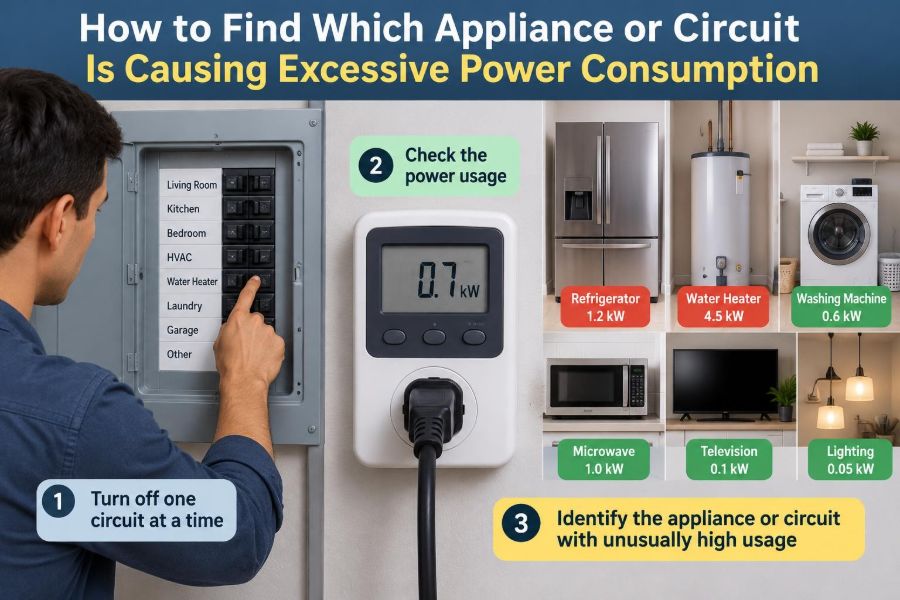
A plug-in energy meter is one of the clearest tools for appliances with a standard plug. Place it between the wall outlet and the appliance, then observe instantaneous watts and accumulated kWh over a representative period.
Short tests are useful for resistive loads such as kettles and heaters. Appliances that cycle, including refrigerators and dehumidifiers, need longer observation because a momentary reading may capture either their low-power idle state or their compressor starting period.
Check the meter’s current and power rating first. Do not connect a high-current appliance to a meter that is not rated for it.
🧲 Measure Circuit Current With a Clamp Meter
A clamp meter measures current by sensing the magnetic field around a conductor. It is valuable for checking branch circuits, provided the measurement can be made safely on an accessible, properly separated conductor.
The clamp must surround one conductor only. Clamping around both live and neutral together causes their magnetic fields to largely cancel, producing a misleading low reading. Measuring inside a panel generally requires removing a cover and should be left to qualified personnel.
Current alone is not always enough to calculate power accurately, particularly with electronic loads. Voltage, power factor, and waveform distortion can affect the relationship.
📊 Consider a Whole-Home Energy Monitor
Some energy monitors use current transformers around service conductors and log power over time. Others integrate with compatible smart meters. Their main advantage is trend visibility: they can show overnight baseload, long heating cycles, and recurring spikes.
These systems are helpful screening tools, not perfect appliance identifiers. Loads with similar signatures can be confused, and installation at service equipment should be performed according to the product instructions and local electrical requirements.
🔀 Isolate Loads by Switching Off Branch Circuits
If the whole-building baseline is unexpectedly high, a controlled breaker test can narrow the search. Turn off one branch breaker at a time, observe the meter rate or monitor reading, and record the change.
A large, repeatable reduction identifies a circuit carrying the suspect load. Then inspect what that circuit supplies without assuming the panel label is correct. One breaker may feed outlets, lighting, and fixed equipment in more than one room.
Restore circuits promptly if they supply refrigerators, alarms, medical equipment, networking hardware, sump pumps, or other essential services.
🏷️ Verify Circuit Labels Instead of Trusting Them
Panel directories are often incomplete after renovations, tenant changes, or DIY alterations. A label such as kitchen outlets may omit a dishwasher, basement receptacle, or exterior device that was later added to the circuit.
With another person present where practical, use a lamp or receptacle tester to map outlets and lights while each breaker is switched. Update the directory clearly. Accurate labels improve future maintenance as well as energy troubleshooting.
🌙 Check Standby and Always-On Loads
Standby power is the consumption of equipment that remains ready to respond: televisions, set-top boxes, game consoles, printers, network hardware, chargers, and smart appliances. Individually, many such loads are modest; together, they can form a persistent base load.
Focus on equipment that remains warm, has external power adapters, or includes network connectivity. Smart power strips can reduce selected entertainment or desk loads, but they should not be used for devices that need continuous power, updates, cooling, or reliable network access.
🔥 Prioritize Resistance Heating Appliances
Devices that deliberately make heat usually deserve early attention because they draw substantial power while active. Examples include space heaters, electric water heaters, ovens, clothes dryers, heated towel rails, underfloor heating, and heat trace cables.
A thermostat fault can cause a heater to run far longer than intended. So can an open window near a space heater, a blocked dryer vent, inadequate insulation around hot-water piping, or an incorrect timer setting.
Do not assume a heater is faulty merely because it uses a large amount of power. Its rating may be normal; the question is whether its runtime matches the heating demand.
🧊 Investigate Refrigerators, Freezers, and Dehumidifiers
Cooling appliances operate in cycles, so a compressor running almost continuously is a useful warning sign. Dirty condenser coils, poor door seals, blocked airflow, a warm room, excessive frost, and incorrect temperature settings can all increase runtime.
For a refrigerator or freezer, listen and observe over several hours rather than judging one cycle. For a dehumidifier, verify that the humidity setting is realistic and that doors and windows are not allowing a steady supply of moist outside air.
A failed component is possible, but heat transfer conditions should be checked before assuming the compressor itself is defective.
💧 Examine Pumps and Water-Related Equipment
Well pumps, booster pumps, circulation pumps, sump pumps, pool pumps, and aquarium systems can consume energy in ways that are easy to miss. A leaking pipe, stuck float switch, failed check valve, or incorrect schedule may make a pump cycle repeatedly.
Watch for short cycling: frequent starts and stops over a short period. Besides wasting energy, this can increase mechanical wear. Water heaters also deserve inspection for hot-water leaks, recirculation settings, and heating elements that remain energized longer than expected.
🌡️ Separate HVAC Use From HVAC Faults
Heating, ventilation, and air-conditioning systems often dominate seasonal energy use. Higher consumption during extreme weather may be expected, but persistent runtime can indicate clogged filters, blocked vents, thermostat placement problems, refrigerant-related faults, or poor building sealing.
A heat pump behaves differently from a resistance heater. Its electrical input is not equal to its heat output, and cold-weather operation may involve defrost cycles or supplemental resistance heat. For this reason, compare operation with the system design and settings rather than using a simple wattage assumption.
🖥️ Do Not Overlook Computing and Entertainment Equipment
Desktop workstations, multi-monitor setups, servers, network-attached storage, audio amplifiers, and gaming systems can have substantial continuous or near-continuous loads. Automatic updates, backups, rendering tasks, and remote-access settings may keep them active outside working hours.
Use operating-system power reports or a plug-in meter to distinguish idle consumption from workload consumption. Sleep settings can help, but a device serving files, backups, or remote connections may need a deliberate schedule rather than an aggressive shutdown rule.
🧯 Understand When Wiring Problems Are Possible
Most excessive consumption is caused by loads, not by electricity mysteriously disappearing in household wiring. However, defective connections can create heat, and certain faults can cause abnormal operation or unsafe conditions.
Signs requiring professional assessment include hot outlets, scorched insulation, flickering lights, voltage changes when appliances start, crackling sounds, or a breaker that trips repeatedly. Energy troubleshooting must not become an excuse to ignore a potential fire or shock hazard.
A qualified electrician can test insulation resistance, connection integrity, voltage drop, circuit loading, and other conditions that are not safely evaluated with basic consumer tools.
🧮 Estimate Expected Energy From Runtime
Once a candidate appliance is identified, calculate a rough expectation and compare it with measurement. Multiply the average power in kilowatts by the hours of operation. For cycling equipment, use the measured average over enough time to include typical cycles.
| Example load | Average power | Runtime | Estimated energy |
|---|---|---|---|
| Space heater | 1.5 kW | 3 hours | 4.5 kWh |
| Network equipment | 0.06 kW | 24 hours | 1.44 kWh |
| Dehumidifier | 0.45 kW | 8 hours | 3.6 kWh |
These are hypothetical examples, not typical values for every model. The calculation is most useful when based on an actual measured average, since rated power and real operating power can differ.
📐 Account for Voltage and Power Factor
For a simple resistive appliance, power is approximately voltage multiplied by current. Motors, electronic power supplies, and variable-speed equipment are more complicated because current and voltage may not align perfectly in time.
Power factor describes part of that relationship. A basic clamp meter may show current, but it may not provide true real power in watts. Use a power meter designed to measure watts and kWh when accuracy matters, especially for electronic loads.
🗒️ Keep a Simple Measurement Log
A log turns scattered observations into evidence. Record the date, weather or ambient conditions, meter reading, breakers changed, appliance status, measured watts or current, and any unusual cycling behavior.
This is especially useful for intermittent faults. A pump may only cycle after rainfall, while a heat pump may show unusual behavior only below a certain outdoor temperature. Without notes, these patterns are easy to overlook.
⏰ Check Time-of-Use and Demand Effects
A higher bill does not always mean more kWh were used. Some tariffs charge different rates by time of day, and some commercial or larger-service arrangements include demand charges based on high simultaneous power draw.
If the total kWh is similar but cost has changed, inspect the tariff details before replacing equipment. Shifting flexible loads, such as laundry or charging, may reduce cost under time-based pricing even though the energy use remains unchanged.
🛠️ Correct the Cause Rather Than Hiding the Symptom
Once a cause is confirmed, select the smallest reliable fix. That may mean adjusting a timer, replacing a worn door gasket, cleaning a coil, repairing a leak, changing a thermostat schedule, or replacing an inefficient appliance at the end of its useful life.
A smart plug or timer can be useful when it suits the appliance, but it is not a cure for a defective heater, overloaded circuit, or unsafe connection. Controls should support safe operation, not bypass the reason the equipment was installed.
🚫 Avoid Common Troubleshooting Mistakes
The most frequent mistake is blaming the largest appliance without measuring its runtime. Another is taking a single instantaneous reading from a cycling load and treating it as its daily average.
- Do not compare bills with different billing periods without normalizing by days.
- Do not reset settings or replace parts before documenting the original behavior.
- Do not turn off unknown breakers and leave essential systems disabled.
- Do not use a plug-in meter beyond its rating or on hard-wired equipment.
- Do not interpret a low current reading as low real power without considering the meter and load type.
👷 Know When to Call a Qualified Electrician
Call a qualified electrician when the suspected issue involves the service equipment, panel interior, hard-wired HVAC equipment, unusual heating, repeated trips, damaged wiring, or unexplained meter activity after all accessible loads are isolated.
Also seek professional help if circuit mapping reveals unexpected shared neutrals, mislabeled breakers, unknown wiring routes, or equipment that cannot be safely disconnected. A licensed HVAC, appliance, or plumbing professional may be the right specialist when the electrical supply is normal but the load is operating abnormally.
✅ Verify the Fix With Another Measurement
After making a change, repeat the same measurement method under similar conditions. If a dehumidifier schedule was changed, compare its kWh over similar humidity conditions. If a circuit was repaired, recheck the overnight baseline.
Verification prevents coincidence from being mistaken for a solution. Seasonal temperature, household activity, and billing dates can otherwise create apparent improvements or regressions that have little to do with the repair.
🧠 Build an Ongoing Energy-Awareness Routine
Periodic meter checks, accurate circuit labels, and occasional appliance measurements make abnormal consumption easier to detect early. For workplaces, assigning responsibility for reviewing energy trends can prevent unattended equipment and schedule errors from persisting for months.
The goal is not to eliminate every watt of standby power or avoid necessary comfort. It is to understand which loads are intentional, which are adjustable, and which indicate equipment that is not operating as intended.
🎯 The Core Principle: Measure, Isolate, Confirm
Effective troubleshooting follows a repeatable sequence: establish a whole-building baseline, identify the time pattern, isolate circuits, measure individual loads, and verify the result after correction. Each step reduces uncertainty without relying on guesswork.
High energy consumption usually has a physical explanation: a device has high power, operates for a long time, or both. The safest and most useful investigation identifies that explanation with appropriate instruments and respects the limits of what can be tested without professional assistance.
When excessive consumption is approached as a measurement problem rather than a guessing game, the responsible appliance or circuit becomes far easier to find and fix. ⚡🔍🏠