
A phone charger, rooftop solar array, electric vehicle, data center, and high-voltage transmission link may appear unrelated. Yet each depends on the same capability: controlling electrical energy precisely enough that it arrives in the right form, at the right time.
Electricity is not simply “on” or “off.” Its voltage, current, frequency, waveform, direction of flow, and timing all matter. A device designed for one electrical condition can fail, waste energy, or behave unpredictably when supplied with another.
For most of the last century, large rotating machines did much of the work of producing and regulating grid electricity. Modern power systems increasingly use electronic converters instead. The inverter is one of the most visible examples, but it belongs to a much broader family called power electronics.
Understanding these systems explains why renewable energy can connect to the grid, why electric motors have become so controllable, and why a changing electricity network needs new approaches to stability and protection.
⚡ Power Electronics: The Electrical Energy Translator
Power electronics is the engineering field concerned with converting, regulating, and switching electrical power. Unlike low-power electronics that mainly process information, such as a sensor circuit or computer processor, power electronics handles energy intended to do useful physical work.
A power converter may change alternating current (AC) into direct current (DC), DC into AC, raise or lower voltage, or control current delivered to a motor, battery, heater, or grid connection. Its purpose is not merely to move power, but to shape it.
A useful analogy is a multilingual interpreter. The source and destination may both involve electricity, but their “languages” differ. Power electronics translates between them while trying to minimize loss and unwanted disturbance.
🔄 What an Inverter Actually Does
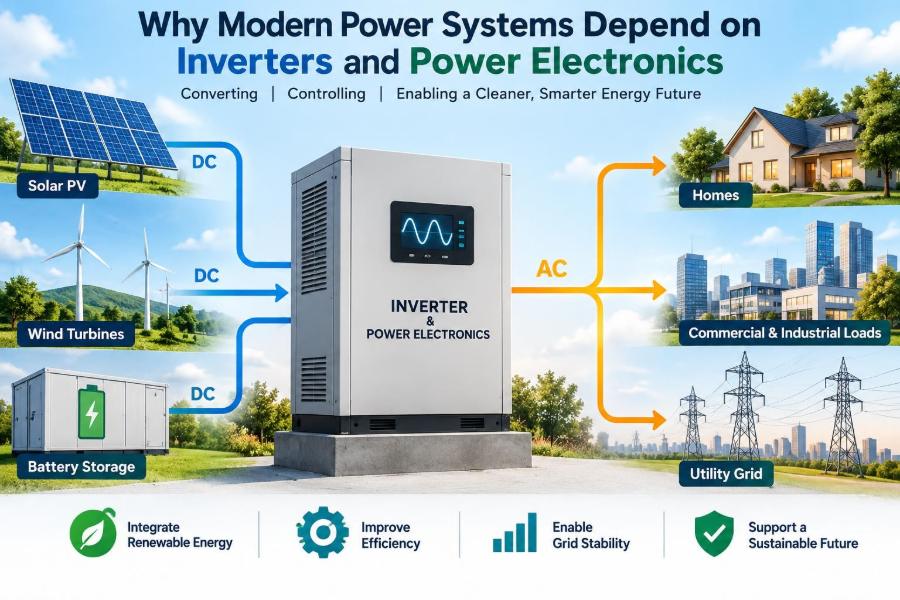
An inverter converts DC electrical power into AC electrical power. Batteries, photovoltaic panels, and many DC power supplies naturally provide DC, where voltage polarity remains in one direction. Utility networks and many conventional loads use AC, where polarity reverses periodically.
An inverter does not usually create a perfectly smooth sine wave directly. It rapidly switches semiconductor devices on and off, creating a controlled sequence of voltage pulses. Filters and the connected electrical system help produce a waveform that closely approximates the required AC output.
In a solar installation, the inverter turns panel output into grid-compatible AC. In an electric vehicle, an inverter turns battery DC into carefully timed AC for the traction motor. The same broad principle supports very different applications.
🔌 The Other Essential Converter Types
Inverters are only one branch of power conversion. Modern equipment often uses several converter stages in series, each solving a different electrical problem.
| Converter type | Main conversion | Typical use |
|---|---|---|
| Rectifier | AC to DC | Battery chargers, DC links, industrial drives |
| Inverter | DC to AC | Solar systems, motor drives, backup power |
| DC-DC converter | One DC voltage to another | Electric vehicles, computers, renewable systems |
| AC-AC converter | AC voltage or frequency to another AC form | Variable-speed drives and specialized supplies |
A laptop charger, for example, first rectifies wall AC into DC, then uses high-frequency switching and a transformer to produce a safe low-voltage DC output. The power path may be compact, but its internal control is sophisticated.
🧱 Why Semiconductors Changed the Power System
Early electrical control often relied on mechanical switches, contactors, resistors, and rotating machines. These remain useful, especially where rugged isolation or simple switching is needed, but they are limited in speed and fine control.
Power semiconductors such as diodes, thyristors, MOSFETs, and insulated-gate bipolar transistors can switch rapidly without moving parts. Their control terminals require relatively little energy compared with the power they direct.
This makes it possible to control energy many thousands of times per second in some applications. Fast switching enables compact converters, accurate motor control, and power-quality functions that would be difficult or inefficient with purely mechanical equipment.
🧭 Switching Is Control, Not Wasteful Interruption
It can seem counterintuitive that repeatedly turning a power path on and off can produce smooth, efficient electricity. The key is that modern switches are designed to spend very little time in their partially conducting region, where both voltage and current are substantial and heat loss is high.
By varying the timing of switching pulses, a controller adjusts the average voltage or current seen by the load. This principle is called pulse-width modulation, or PWM. Wider pulses transfer more average energy; narrower pulses transfer less.
The switching frequency must be selected carefully. Higher frequencies can reduce filter size and improve control response, but they can also increase switching losses, electromagnetic interference, and thermal stress.
〰️ Producing a Usable AC Waveform
A grid-connected inverter must produce voltage that is compatible with the network’s frequency, phase angle, and acceptable waveform quality. It measures grid conditions continuously and synchronizes its output before transferring significant power.
PWM produces high-frequency components in addition to the desired fundamental AC waveform. Inductors and capacitors, often arranged as output filters, attenuate these unwanted components. The remaining waveform is much closer to a sinusoid.
Waveform quality matters because distortion can increase heating, interfere with equipment, and complicate voltage regulation. A converter should therefore be evaluated not only by its power rating, but by its behavior over changing loads and network conditions.
🌞 Solar Power Needs Inverters at the Grid Edge
Solar photovoltaic modules generate DC, and their voltage changes with sunlight level, temperature, and operating point. A utility grid cannot simply accept this variable DC output from thousands or millions of separate sources.
A solar inverter performs several jobs at once: it finds a productive panel operating point, converts DC to AC, synchronizes with the grid, limits harmful current under abnormal conditions, and disconnects when required for safety.
For a home system, the inverter can also report production and detect faults. For a large solar plant, many inverters or centralized conversion units coordinate substantial power while supporting voltage control at the connection point.
🎯 Maximum Power Point Tracking Extracts More Solar Energy
A photovoltaic panel has a voltage-current relationship rather than one fixed output. For a given sunlight and temperature condition, there is typically an operating point at which the panel supplies its maximum available power.
Maximum power point tracking, commonly called MPPT, is a control function that adjusts the converter’s electrical loading so the panels operate near that point. It is not a source of extra sunlight; it is a way to avoid leaving usable panel output uncollected.
MPPT is particularly valuable when conditions change through the day. Partial shading complicates the task because different panel sections may behave differently, which is one reason array design and inverter configuration deserve careful engineering.
🔋 Batteries Depend on Bidirectional Conversion
A battery stores and releases DC energy, while most buildings and grids operate primarily with AC. A battery energy storage system therefore needs conversion in both directions: AC to DC during charging and DC to AC during discharge.
Bidirectional converters manage this exchange while respecting battery limits. They regulate current, maintain suitable voltage ranges, and coordinate with the battery management system, which monitors cell temperature, state of charge, and other operating conditions.
This enables applications such as backup power, peak-demand reduction, renewable smoothing, and frequency response. It does not make a battery unlimited: stored energy, converter rating, thermal limits, and control settings all constrain what the system can deliver.
🚗 Electric Vehicles Turn Batteries into Motion
Electric vehicle traction batteries provide DC, but many traction motors require controlled multiphase AC. The vehicle inverter creates those phase currents and continually adjusts their magnitude and timing as the driver accelerates, cruises, or slows down.
That precision provides high torque at low speed and efficient operation across a wide speed range. During regenerative braking, the control system reverses the energy flow so the motor acts as a generator and sends some kinetic energy back toward the battery.
Regeneration is limited by tire grip, battery acceptance, temperature, state of charge, and comfort requirements. It is valuable, but friction brakes remain necessary for complete stopping capability and certain driving conditions.
🏭 Variable-Speed Drives Reduce Mechanical Compromise
Many industrial motors once ran at essentially fixed speed, with valves, dampers, throttles, or mechanical gearing used to control the process. A variable-frequency drive rectifies incoming AC, creates a DC link, and inverts it into AC at a chosen frequency and voltage.
Because motor speed is related to supply frequency, this lets a pump, fan, conveyor, or compressor operate closer to what the process actually needs. For loads such as centrifugal pumps and fans, reducing speed can significantly reduce required mechanical power.
Drives also provide soft starting, controlled acceleration, torque limiting, and diagnostic information. Their benefits depend on correct motor compatibility, cable design, grounding, and configuration; simply adding a drive is not automatically a complete energy solution.
🌬️ Wind Turbines Need Electrical Decoupling
Wind speed varies constantly, while a conventional AC grid expects tightly controlled frequency. Power electronic converters allow modern wind turbines to operate over a range of rotor speeds while delivering grid-compatible electricity.
Depending on the turbine design, conversion equipment may process all generator output or only part of it. In either case, it helps decouple the generator’s changing electrical behavior from the requirements of the grid.
This flexibility supports aerodynamic efficiency and controllable power output. It also means the turbine’s grid response is determined substantially by software and converter hardware, not only by the physical inertia of a rotating generator.
🏙️ High-Voltage DC Solves Specific Transmission Problems
High-voltage direct current, or HVDC, uses powerful converter stations at each end of a DC transmission link. One station converts AC to DC for transmission; the other converts it back to AC for the receiving network.
HVDC can be attractive for very long distances, long submarine or underground cables, and controlled connections between AC systems that are not synchronized. It offers direct control of power flow in ways conventional AC lines generally do not.
However, converter stations are complex and costly, so HVDC is not automatically preferable for every route. Network planning weighs distance, cable type, system strength, controllability, reliability needs, and the value of interconnection.
🧩 DC Links Create a Controllable Energy Buffer
Many converters include a DC link: an intermediate DC stage, often supported by capacitors and sometimes inductors. It sits between an input conversion stage and an output conversion stage.
The DC link allows the two sides to operate somewhat independently. A motor drive can take fixed-frequency grid AC at its input while producing variable-frequency AC at its output. A back-to-back grid interconnector can join networks operating at different frequencies.
DC-link capacitors store only a limited amount of energy, but they help smooth short-term power differences and reduce voltage ripple. Their design is critical because ripple current and temperature can strongly affect lifetime.
🕹️ Grid-Following Inverters Need a Voltage Reference
Most existing distributed solar inverters are grid-following. They detect a stable grid voltage waveform, synchronize to it, and inject a controlled current. In simple terms, the grid provides the rhythm and the inverter adds power in step with it.
This works well when nearby synchronous generators or other sources establish a strong voltage and frequency reference. It becomes more challenging in weak grids, isolated networks, or locations with a high proportion of converter-connected generation.
Grid-following behavior is not a defect. It is a design choice suited to a particular system context. As the grid changes, designers must ensure that enough equipment can establish and maintain the reference others follow.
🧠 Grid-Forming Inverters Can Establish Voltage and Frequency
A grid-forming inverter is controlled to establish an AC voltage waveform rather than merely follow an existing one. It can be used in islanded microgrids, battery-backed systems, and increasingly in networks where conventional rotating generation is less dominant.
Its controller must respond to changes in load and network conditions while keeping voltage and frequency within acceptable bounds. Some approaches emulate aspects of synchronous-machine behavior; others use different control strategies with similar system-level goals.
Grid-forming capability is promising, but it is not a universal switch that solves every stability problem. Protection coordination, energy availability, fault response, communications, and interactions among many controllers remain essential engineering concerns.
⏱️ Frequency Stability Is Changing
In traditional power systems, large spinning generators store kinetic energy in their rotating masses. When a sudden imbalance occurs between generation and demand, that inertia initially slows the rate at which frequency changes.
Power electronic resources are electronically decoupled from much of that natural mechanical response. Their behavior during a disturbance depends on control design, available energy, current limits, and grid-code requirements.
Converters can react very quickly, including through battery support or controlled power reduction. Yet fast response must be coordinated. A network benefits from a deliberate mix of resources and controls rather than assuming all fast devices will automatically produce a stable outcome.
📉 Voltage Support Is Often Local
Frequency is broadly shared across a synchronized AC system, but voltage problems are often strongly local. Long feeders, reactive power demand, cable capacitance, and changing generation can all affect voltage at a particular point.
Inverters can control reactive power, which is power exchanged with electric and magnetic fields rather than consumed as net useful energy over a cycle. By adjusting reactive current within their ratings, they can help regulate local voltage.
There is a trade-off: an inverter has a finite current capability. When it is delivering high real power, less capacity may remain for reactive support unless it is oversized or operated with suitable limits.
🧮 Real Power and Reactive Power Serve Different Jobs
Real power, measured in watts, represents net energy converted into work, heat, light, or stored energy. Reactive power, measured in volt-amperes reactive, moves back and forth between the grid and reactive components such as inductors and capacitors.
Both affect equipment loading and network operation. A useful mental picture is carrying supplies in a vehicle: real power is the cargo that accomplishes the delivery, while reactive power is part of the capacity needed to manage the journey.
Power-factor correction and inverter reactive-power control can reduce unnecessary current in certain situations. But the correct target depends on the electrical network, local rules, equipment ratings, and the needs of voltage control.
🛡️ Protection Becomes Harder with Converter-Dominated Sources
Traditional protection schemes often use high fault currents from synchronous generators to identify and isolate faults rapidly. Many inverters limit their output current to protect semiconductor devices, sometimes supplying only a modest multiple of normal current.
That changes what relays and fuses can “see.” Fault current magnitude, direction, waveform content, and duration may differ from the assumptions behind older protection arrangements.
Engineers address this with updated relay settings, directional or communication-assisted protection, converter controls designed for fault ride-through, and detailed network studies. Protection must be designed for the actual source mix, not copied from a simpler historical system.
🔒 Anti-Islanding Protects People and Equipment
An island occurs when a section of network becomes electrically separated from the main grid but continues to be energized by local generation. An unintended island can endanger utility workers, expose customer equipment to unstable voltage and frequency, and complicate restoration.
Grid-connected inverters therefore detect abnormal grid conditions and disconnect when required. They may use local measurements, active test methods, communication signals, or combinations of these approaches depending on the application and governing requirements.
Intentional islanding is different. A properly designed microgrid can separate from the main grid and continue serving selected loads, but it needs suitable switches, protection, energy resources, controls, and operating procedures.
🌊 Harmonics and Electromagnetic Interference Need Attention
Switching converters can introduce harmonic currents and high-frequency voltage components. Harmonics are waveform components at integer multiples of a fundamental frequency; other switching effects can extend beyond the harmonic range typically considered in basic power-quality analysis.
Excessive distortion can heat transformers, capacitors, motors, and neutral conductors, while electromagnetic interference can affect nearby communication or control circuits. The risk depends on converter topology, switching strategy, cable layout, grid impedance, filters, and the connected equipment.
Mitigation may include line reactors, passive or active filters, shielded cables, careful grounding, and sound enclosure design. Measurement and modeling matter because a mitigation method that works in one installation may not address a different resonance or coupling path.
🌡️ Thermal Design Determines Reliability
Even efficient converters produce heat through conduction losses, switching losses, magnetic components, capacitors, and auxiliary systems. Semiconductor junction temperature must remain within allowable limits across expected ambient conditions and load cycles.
Heat sinks, fans, liquid cooling, thermal interface materials, and cabinet airflow all influence reliability. Dust accumulation, blocked filters, failed fans, and high ambient temperature can quietly reduce equipment life or trigger derating.
Repeated temperature cycling matters as well. It can stress solder joints, bond wires, connectors, and other materials over time. Thermal management is therefore part of electrical design, mechanical design, and maintenance planning.
📦 Size, Rating, and Overload Capability Are Different Questions
Choosing an inverter by its headline kilowatt rating alone is a common mistake. A design must consider continuous power, short-duration overload, AC voltage range, DC voltage range, current limits, power factor, ambient temperature, cooling conditions, and expected load behavior.
Motor loads may require substantial starting or acceleration torque. A battery inverter may be limited by battery current even when its AC rating appears adequate. A solar inverter may need clipping analysis when array DC capacity exceeds AC output capacity by design.
Derating curves are especially useful. They show when equipment must reduce output because of temperature, altitude, voltage, switching frequency, or other constraints. The safe operating point is a system question, not just a catalog number.
🔧 Installation Details Can Decide Performance
Good converter hardware can perform poorly when installed carelessly. Cable length, conductor routing, enclosure ventilation, grounding method, surge protection, disconnect placement, and terminal torque all affect safety and operation.
Long motor cables, for example, can create steep voltage reflections that stress motor insulation. Sensitive control wiring routed beside high-current switching conductors can pick up noise. Ground loops may create measurement errors or interference.
A careful installation follows the manufacturer’s instructions, applicable electrical codes, and the project’s engineering documentation. For high-energy systems, qualified personnel should perform design, commissioning, testing, and maintenance.
🧰 Monitoring Turns Data into Preventive Maintenance
Modern converters typically measure voltage, current, temperatures, energy flow, alarms, and switching-related conditions. This data can reveal gradual problems before a total failure occurs.
Useful warning signs include repeated thermal derating, unusual DC-link ripple, fan alarms, insulation faults, declining solar yield relative to comparable conditions, or recurring grid-disconnection events. No single measurement proves a cause, but trends guide inspection.
Remote monitoring is valuable only when paired with sensible alarm priorities and clear response procedures. A flood of low-value notifications can hide the few events that demand quick action.
🕸️ Digital Control Adds Cybersecurity Responsibilities
Network-connected inverters and energy management systems can be monitored, updated, and coordinated remotely. That improves maintenance and enables advanced grid functions, but it also expands the system’s digital attack surface.
Practical safeguards include changing default credentials, controlling remote access, segmenting operational networks where appropriate, applying tested firmware updates, maintaining backups of configurations, and logging access and changes.
Cybersecurity should not be treated as separate from electrical reliability. A compromised controller could affect availability, settings, or coordinated behavior, so technical and operational controls need to be planned together.
🏘️ Microgrids Show the Full System Challenge
A microgrid combines local generation, loads, storage, controls, and switching so it can operate with the wider grid or, when designed to do so, independently for a period. It is a practical setting where inverter capabilities become highly visible.
Consider a hypothetical campus microgrid with solar panels, batteries, backup generation, and critical laboratory loads. During normal operation, it may reduce peak demand and optimize local energy use. During an outage, it must rapidly balance generation and demand while maintaining acceptable voltage and frequency.
Success depends on more than installing batteries and inverters. Load prioritization, black-start planning, protection settings, fuel or energy availability, and tested transition sequences determine whether the microgrid is genuinely resilient.
⚖️ Power Electronics Bring Trade-Offs, Not Magic
Converters provide flexibility, speed, and precise control, but they introduce switching losses, harmonic concerns, thermal limits, software complexity, and different fault behavior. Their components may also have finite lifetimes that require planned replacement.
Conventional rotating machines retain valuable attributes, including physical inertia and well-understood fault contribution. Passive equipment such as transformers, capacitors, and reactors also remains fundamental. Modern systems are not replacing every older technology with a single electronic device.
The strongest designs use each technology where it fits. Power electronics expands the options available to engineers; it does not remove the need for careful network studies and sound operational judgment.
🎓 What Students and Practitioners Should Learn First
A useful learning path starts with circuit fundamentals: sinusoidal AC, phasors, power factor, three-phase systems, inductors, capacitors, and transformers. These ideas explain what converters are trying to control.
Then study semiconductor switching, PWM, rectifiers, inverters, filters, control loops, and thermal losses. Simulation is helpful, but it should be paired with awareness of nonideal effects such as dead time, sensor noise, parasitic inductance, and saturation.
- Read datasheets for voltage, current, temperature, and switching limits.
- Learn why grounding and layout affect both safety and signal quality.
- Practice interpreting waveforms with appropriate measurement tools.
- Treat high-energy testing as a safety-critical activity, not a casual experiment.
🚀 The Next Design Challenge Is Coordination at Scale
The future challenge is not simply building more inverters. It is coordinating enormous numbers of converters, storage systems, flexible loads, and conventional resources so they behave predictably as a power system.
Standards, grid codes, interoperability, model validation, protection design, and operator training all matter. Controls that work well for one device can interact unexpectedly when thousands of devices respond to the same voltage or frequency event.
This is why power electronics increasingly sits at the intersection of electrical machines, power systems, communications, software, and cybersecurity. The converter is both a power device and a controlled participant in a larger network.
✅ The Core Principle: Electricity Must Be Shaped, Not Just Generated
Modern power systems depend on inverters and power electronics because electricity must be matched to its source, destination, and network conditions. Solar panels, batteries, wind generators, motors, transmission links, and sensitive loads all operate more effectively when voltage, frequency, current, and timing can be controlled.
The same capability creates new responsibilities. Engineers must account for grid stability, protection, waveform quality, heat, installation practice, communications, and cybersecurity. The essential question is no longer only where energy comes from, but how it behaves at every point between source and use.
Inverters are the controllable bridges that let a modern power system connect diverse energy sources and loads without requiring them to produce or consume electricity in exactly the same form. ⚡🔋🌐