
A light flickers when a heater starts. An extension lead feels warm under a desk. A motor runs, but its housing is hotter than usual and the electricity bill has climbed without an obvious change in production.
These are easy details to ignore because electrical systems usually work silently—until they do not. Yet the same conditions that waste energy can also reveal overloaded conductors, loose connections, poor equipment selection, or neglected maintenance.
Electrical safety and energy efficiency are not separate housekeeping tasks. They meet at a practical question: is electrical energy reaching the intended load through equipment that is correctly sized, protected, connected, and maintained?
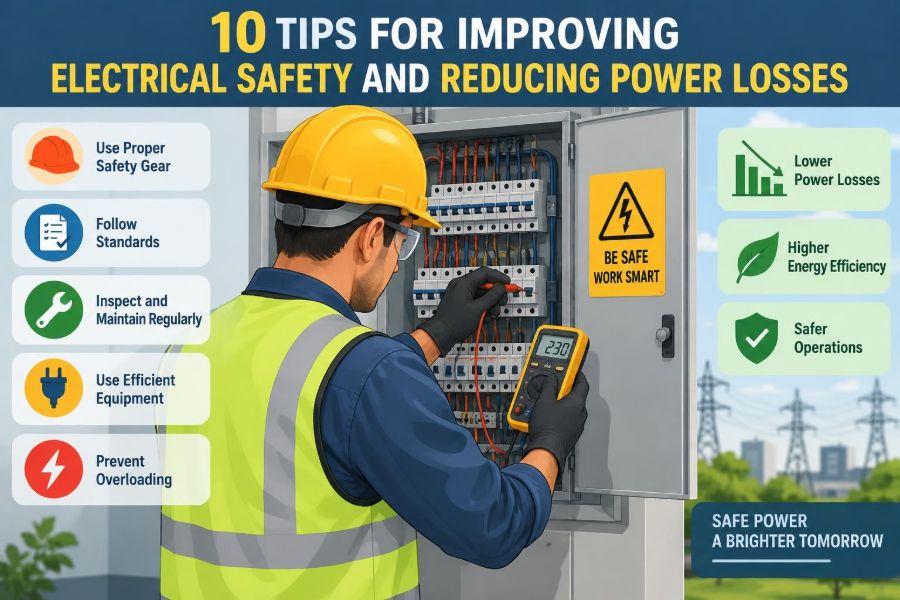
The following ten tips apply that question from the service entrance to everyday plug loads. They are useful for students learning the fundamentals and for professionals building safer, lower-loss installations. Work inside energized panels, switchgear, or fixed wiring belongs to competent, authorized people using the required procedures and protective equipment.
🔍 1. Start by Finding Where Energy Is Going
Power loss is not always a mysterious defect. Some energy becomes useful work, such as light, heat, motion, or computing. Loss is the part converted unintentionally—usually to heat, noise, vibration, or standby consumption.
Begin with a simple load inventory. Identify major loads, their ratings, operating hours, and whether they run continuously or intermittently. Comparing this list with utility intervals or submeter readings often points to the systems worth investigating first.
- Resistive heating and hot-water equipment commonly dominate deliberate electrical heating.
- Motors, pumps, fans, and compressors may dominate in workshops and commercial buildings.
- Always-on electronics, lighting, and idle equipment can create persistent base load.
Measurement is more useful than assumption. A clamp meter, energy meter, thermal inspection, or building management trend can reveal a pattern, but each must be used within its rating and by someone qualified to interpret the result.
⚙️ 2. Understand Why Resistance Creates Heat
Conductor loss is often described by the relationship P = I²R, where power loss P depends on current I and resistance R. Current has a squared effect: doubling current produces four times the resistive heating if resistance stays the same.
This explains why a modest overload can become serious, why undersized conductors run hot, and why long cable runs deserve attention. It also explains why reducing unnecessary current can lower both energy waste and thermal stress.
Resistance rises with length and falls with larger conductor cross-sectional area. Material, temperature, joints, and corrosion matter as well. A cable that appears intact can still lose excessive power if it is too small for its load and route.
📉 3. Treat Voltage Drop as Both a Performance and Safety Clue
Voltage drop is the reduction in voltage along a conductor caused by its impedance. Every circuit has some drop, but excessive drop can leave equipment operating below its intended voltage.
Motors are especially sensitive in some applications. Low terminal voltage may reduce available starting or running torque while current and heating behavior change. Lighting can dim, electronic power supplies may misbehave, and contactors can chatter.
For a new installation, calculate voltage drop using the actual conductor material, size, route length, load current, system type, and applicable local rules. For an existing circuit, measure voltage at the source and at the load under meaningful operating conditions. A measurement at no load may hide the problem.
🧵 4. Size Conductors for the Entire Installation
Choosing wire by ampacity alone is incomplete. Ampacity is the current a conductor can carry under stated installation conditions without exceeding its permitted temperature limit. Those conditions can change dramatically in the field.
Ambient temperature, grouping in conduit or tray, thermal insulation, soil conditions, terminations, harmonic currents, and duty cycle can all affect a conductor’s usable capacity. The overcurrent protective device must coordinate with the conductor and the load.
A larger conductor can reduce voltage drop and I²R loss, but it is not automatically the best answer. It adds cost, may require larger fittings, and does not correct a bad joint or an overloaded circuit. Design the conductor, insulation, protection, and installation method as one system.
🔩 5. Make Sound, Correctly Torqued Connections
A loose or contaminated connection creates a small area of high resistance. Current through that resistance generates heat, which can oxidize the contact surface, relax hardware, and increase resistance further. This feedback loop is a common reason terminations overheat.
Use terminals listed for the conductor material and size. Prepare the conductor to the manufacturer’s instructions, avoid damaged strands, and use the specified tightening torque with an appropriate calibrated tool. “Tight by feel” is not a reliable electrical method.
Never apply anti-oxidation compounds, solder, or improvised hardware simply because it seems helpful. Materials and connection methods must be compatible with the equipment listing and the applicable installation requirements.
🌡️ 6. Use Heat as an Early Warning Signal
Electrical heat is not always visible. Discoloration, a hot-plastic smell, humming, or a warm cover can be warning signs, but waiting for them is poor practice. Infrared thermography can compare similar components under load and highlight unusual temperature differences.
A warm component is not automatically defective. A breaker, transformer, or motor may normally run above room temperature. The meaningful question is whether its temperature is abnormal for its loading, design, surroundings, and comparable phases or circuits.
Thermal scans should be performed with a defined inspection route and suitable load conditions. They are a screening tool, not a substitute for verifying torque, current balance, insulation condition, and equipment history.
🛡️ 7. Match Protection Devices to the Hazard
Circuit breakers and fuses primarily protect conductors and equipment from overcurrent. They do not guarantee protection from every shock, arc, overheating, or equipment-failure scenario.
Select protective devices with the correct voltage rating, interrupting rating, trip characteristics, and coordination for the system. A protective device must be able to safely interrupt the available fault current at its installed location.
Ground-fault and residual-current protection can reduce shock risk in appropriate applications by disconnecting when it detects unintended current imbalance. Arc-fault protection can address certain arcing conditions. Requirements and terminology vary by jurisdiction, so installation decisions must follow the governing code and manufacturer instructions.
⏚ 8. Maintain Grounding and Bonding Paths
Grounding connects a system to earth for system reference and fault-management purposes. Bonding connects exposed conductive parts together so they remain at substantially the same potential and provide an effective fault-current path. The distinction matters.
A grounding electrode alone is generally not intended to clear a line-to-case fault quickly. The low-impedance bonding and fault-return path, together with the protective device, is what enables prompt operation in many systems.
Do not remove a protective earth conductor to stop nuisance tripping, noise, or hum. That can turn a manageable troubleshooting issue into an exposed-metal shock hazard. Investigate the underlying fault, leakage, wiring error, or incompatible equipment instead.
🔌 9. Avoid Overloading Receptacles and Extension Leads
Power strips and extension cords are convenient, but they are often treated as permanent wiring. Their rating may be lower than the branch circuit rating, and coiled, covered, damaged, or daisy-chained leads cannot shed heat properly.
High-power appliances such as space heaters, kettles, microwaves, and many portable tools deserve a suitable dedicated receptacle circuit where required. A multi-outlet strip is not a way to create additional circuit capacity.
- Use only cords and power strips rated for the voltage, current, and environment.
- Keep cords visible and uncompressed; do not route them under rugs, doors, or furniture.
- Replace cracked plugs, loose receptacles, and damaged insulation rather than taping over defects.
When temporary power becomes permanent, install permanent wiring designed for that load.
💡 10. Reduce Lighting Losses Without Reducing Visibility
Efficient lighting begins with the task, not just the lamp wattage. A corridor, inspection bench, warehouse aisle, and emergency exit each need different light distribution, control, color quality, and reliability.
LED luminaires often reduce energy use and maintenance compared with older technologies, but product quality and thermal environment matter. Poorly selected drivers, enclosed fixtures, or incompatible dimmers can shorten life or cause flicker.
Use occupancy sensors where spaces are genuinely intermittent, daylight controls near windows or skylights, and zoning so one switch does not illuminate an entire floor unnecessarily. Maintain enough safe background lighting for circulation, security, and operational needs.
🔄 Improve Motor System Efficiency
Motors consume a large share of electricity in many facilities, yet the motor is only one part of the system. The driven pump, fan, gearbox, belt, valve, damper, and control strategy determine whether electrical input becomes useful output.
Check alignment, belt tension, bearing condition, lubrication practices, and mechanical loading. A dragging bearing or misaligned coupling wastes power while raising motor temperature and shortening component life.
For variable-torque loads such as many fans and centrifugal pumps, changing speed can be more efficient than throttling flow with a damper or valve. A variable-frequency drive can help, but it must be correctly applied, protected, and considered for harmonics, cooling at low speed, and cable effects.
🧲 Balance Three-Phase Loads
In a three-phase system, reasonably balanced phase loading helps use conductors and transformers effectively. Significant imbalance can increase neutral current in suitable system configurations, create unequal voltage drop, and cause one phase of equipment to run hotter than the others.
Measure each phase under representative load. Do not rely only on panel labels; loads change as equipment is added, moved, or retired. Redistributing single-phase loads may improve balance, but it must be planned so circuit identification and protection remain correct.
Some nonlinear electronic loads create harmonic currents that require separate evaluation. A simple phase-current balance check is valuable, but it is not a complete power-quality study.
📊 Look Beyond Kilowatts to Power Factor
Real power, measured in kilowatts, performs useful work. Apparent power, measured in kilovolt-amperes, reflects the total voltage-current demand. Power factor describes how effectively current is converted into real power in an AC system.
Inductive loads such as motors and transformers can draw reactive power. Low power factor may increase current for a given useful power, increasing conductor losses and using capacity in transformers and distribution equipment.
Capacitor correction can improve power factor in some systems, but it is not a universal add-on. Switching conditions, harmonic resonance, varying loads, and utility arrangements must be assessed. Incorrect correction can create overvoltage or power-quality problems.
🌊 Manage Harmonics From Nonlinear Loads
Nonlinear loads draw current in pulses rather than a smooth sine-wave shape. Common examples include many switch-mode power supplies, LED drivers, variable-frequency drives, and battery chargers. These currents can contain harmonic frequencies.
Harmonics may add heating to transformers, conductors, and neutral paths, interfere with sensitive equipment, or distort voltage where the source impedance is significant. The effect depends on load mix, system design, and equipment characteristics.
When symptoms include unexplained neutral heating, repeated capacitor problems, transformer overheating, or erratic electronic behavior, obtain measurements from a qualified power-quality professional. Remedies may include circuit segregation, properly designed filtering, suitable transformers, or equipment changes—not guesswork.
🕰️ Eliminate Idle and Standby Consumption
Some loads consume little power individually but operate all day: displays, network hardware, chargers, control transformers, vending equipment, and unused process auxiliaries. The relevant question is not whether each load is small, but how long it remains energized.
Schedule equipment around actual occupancy and production. Use automatic shutdown features where they do not compromise safety, cybersecurity, data integrity, ventilation, freeze protection, or required monitoring.
A useful exercise is to compare overnight or weekend base load with what truly needs to remain on. Investigate unexpected demand before adding controls; a compressor cycling after hours may be signaling a leak or control fault.
🧰 Maintain Equipment Before It Fails
Maintenance reduces losses when it addresses physical causes: dirty heat exchangers make motors work harder, worn bearings increase friction, blocked ventilation raises temperature, and degraded contacts add resistance.
Build a maintenance plan around criticality and operating conditions rather than applying the same interval to every asset. Record readings, repairs, thermal observations, insulation-test results where appropriate, and recurring trips. Trends make small changes visible.
De-energize, isolate, lock out, and verify absence of voltage before maintenance where required. Testing for dead is a deliberate safety step, not an assumption based on a switch position or indicator lamp.
📋 Label Circuits and Keep Documentation Current
Accurate labels reduce the chance of working on the wrong circuit and shorten fault isolation. A panel schedule should identify what a circuit actually serves, not merely what someone thought it served years earlier.
Keep one-line diagrams, load schedules, protective-device settings, and equipment manuals available to authorized personnel. Update them after modifications. An undocumented change can make future maintenance slower and can undermine coordination or capacity assumptions.
Clear documentation also helps find energy-saving opportunities. If nobody knows which breaker feeds an air handler or process skid, it is difficult to meter, schedule, or troubleshoot it responsibly.
🧪 Test Protective Functions, Not Just Appearance
A breaker handle in the ON position does not demonstrate that its trip function, accessory contacts, or associated control circuit will work as intended. Likewise, a test button on a protective device usually checks only part of its mechanism.
Inspection and testing should follow the equipment manufacturer’s instructions, site procedures, and applicable standards. Critical systems may need planned functional tests, calibration, or injection testing performed by qualified technicians.
Testing can introduce operational risk if it trips essential equipment. Plan outages, notify affected users, establish safe contingencies, and restore settings carefully. Safety testing is most reliable when it is controlled rather than improvised.
🚫 Never Defeat a Protective Device to Keep Running
Repeated tripping is frustrating, especially when it interrupts work. Replacing a breaker with a larger rating, bypassing an interlock, removing a ground pin, or repeatedly resetting a device without diagnosis can conceal the condition that protection is reporting.
The cause may be overload, short circuit, insulation damage, moisture, a failing motor, inrush characteristics, incorrect device selection, or a wiring error. Each calls for a different remedy.
Record when the trip occurs, what equipment was operating, and whether conditions such as rain, heat, or startup are involved. This information helps qualified troubleshooters find the cause without normalizing unsafe operation.
🏭 Design for the Actual Environment
Electrical equipment that is suitable in a dry office may be unsuitable in a wet washdown area, dusty workshop, corrosive plant, outdoors, or hazardous location. Environment affects enclosure selection, corrosion, insulation aging, contamination, and shock risk.
Water and conductive dust can create leakage paths. Heat reduces component life and conductor capacity. Vibration can loosen terminals. Select equipment with ratings appropriate to the exposure, and preserve enclosure integrity after installation.
Field modifications deserve care. An extra conduit entry, missing gasket, incorrect cable gland, or open knockout can defeat the protection an enclosure was designed to provide.
🔋 Use Backup Power With Clear Boundaries
Generators, uninterruptible power supplies, batteries, and solar-connected systems improve continuity, but they add sources of energy that may remain present after a normal utility disconnect is opened. Isolation, labeling, transfer equipment, grounding arrangements, and maintenance become more complex.
Never connect a portable generator to building wiring through an improvised receptacle connection. Backfeeding can energize conductors unexpectedly and endanger workers or damage equipment. Use correctly installed transfer equipment.
Backup systems also have losses: battery charging, inverter conversion, cooling, and idle consumption. Size and operate them for the loads that truly need continuity, not merely for convenience.
📐 Consider Lifecycle Cost, Not Purchase Price Alone
The cheapest component can cost more over its service life if it wastes energy, fails early, requires frequent replacement, or creates difficult maintenance. Conversely, premium equipment is not justified if its additional capability is never used.
Compare options using the expected duty cycle, energy use, demand effects where relevant, maintenance access, replacement availability, and reliability consequences. This is especially useful for motors, pumps, lighting, transformers, and large HVAC equipment.
A balanced decision considers safety first, then technical suitability and total operating cost. Energy savings should never be pursued by reducing required protective measures or operating margins.
👥 Train People to Recognize Electrical Risk
Many incidents begin with ordinary actions: using a damaged lead, opening a panel without authorization, assuming a circuit is dead, or ignoring a recurring warm plug. Training gives people a clear boundary between safe observation and work that requires qualified personnel.
Practical training should cover reporting routes, emergency response, lockout/tagout responsibilities where applicable, correct use of portable equipment, and the limitations of personal protective equipment. PPE reduces exposure; it does not make hazardous work casual.
Encourage reporting of near misses and abnormal conditions without blame. A hot connection identified early can be repaired during planned downtime instead of becoming an outage or fire event.
📝 Build a Simple Inspection Routine
A regular walk-through catches conditions that instruments may miss between formal inspections. Keep it focused: look for damaged cords, blocked panels, missing covers, moisture, overloaded temporary wiring, unusual noise, and evidence of overheating.
For energy, note equipment running when it should be off, compressed-air leaks, lights in unoccupied zones, and controls overridden indefinitely. Photograph and log issues according to site policy so they can be tracked to completion.
- Daily or weekly: visual defects, housekeeping, abnormal operation.
- Periodic: current readings, thermal checks, mechanical condition, and protective-device maintenance as appropriate.
- After changes: update labels, verify settings, inspect workmanship, and confirm the intended operation.
The interval depends on risk, environment, duty, and local requirements. A wet industrial area needs a different routine from a lightly used classroom.
🧭 Prioritize the Highest-Risk, Highest-Loss Problems
Not every improvement deserves equal urgency. Exposed live parts, overheating connections, damaged insulation, missing bonding, and overloaded circuits demand prompt action because consequences can be severe.
Then address substantial recurring losses: continuously operating equipment, poor control schedules, excessive voltage drop, mechanical drag, and inefficient process control. Metering and inspection help distinguish a major opportunity from a minor annoyance.
A practical priority list includes the hazard, observed condition, likely cause, responsible person, required outage, and verification method. This turns scattered observations into work that can be completed and checked.
✅ The Core Principle: Safe Energy Is Well-Managed Energy
The ten tips connect through one principle: electricity should travel through correctly designed and maintained paths, protected against faults, and used only when it produces needed work. Heat, voltage drop, nuisance trips, and unexplained consumption are often signals that one part of that chain needs attention.
Start with load awareness, then improve conductor sizing, connections, protection, controls, and maintenance. Use measurements to confirm decisions, and bring qualified professionals into any task involving fixed wiring, energized equipment, fault analysis, or code compliance.
Efficiency measures work best when they reduce waste at the source rather than shift risk elsewhere. A safer connection, a correctly controlled motor, and a clearly documented circuit can each prevent losses while making the whole installation easier to operate.
Electrical safety and lower power losses both come from disciplined design, careful installation, regular verification, and respect for the limits of every component. Small observations made early can protect people, equipment, and energy budgets alike. ⚡🛡️🔧