
A workshop owner adds a larger air compressor. At home, someone replaces an old electric heater with a more powerful model. In both cases, the circuit breaker begins to trip.
The interruption is inconvenient, so the tempting solution can seem obvious: replace the breaker with one that has a higher ampere rating. The lights stay on, the machine runs, and the nuisance appears to be gone.
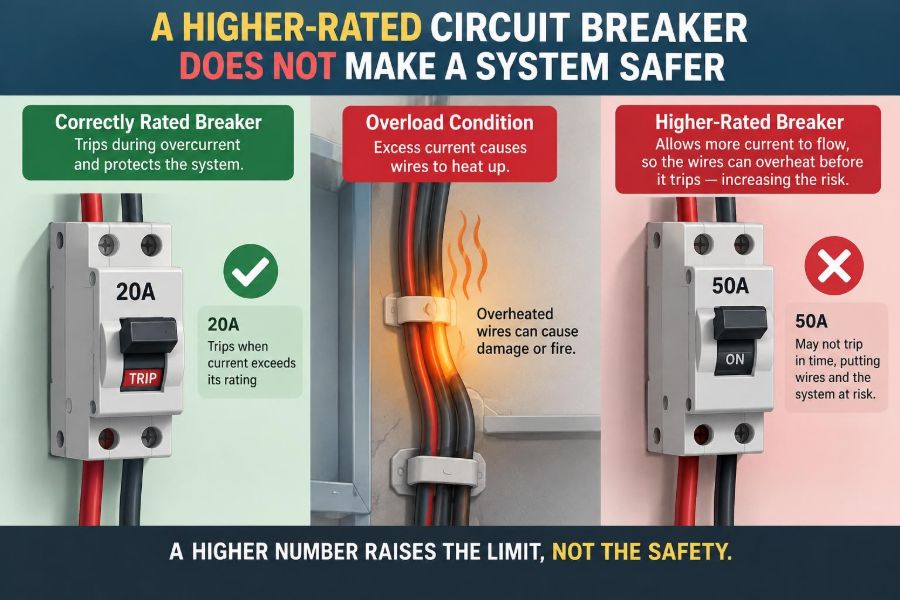
But a breaker is not chosen to make a circuit more powerful. It is chosen to protect the conductors, connections, and equipment connected to that circuit. Raising its rating without redesigning the circuit can remove the very protection that was preventing overheating.
This distinction matters to students learning power systems and to professionals diagnosing field problems. A higher-rated breaker can be entirely correct in a properly engineered upgrade—and dangerously wrong as a quick fix.
⚡ The Myth Behind the “Bigger Is Safer” Idea
The myth often comes from a reasonable intuition: a larger device sounds more robust. In some applications, equipment with a greater rating has more capacity. A larger transformer can serve more load, and a larger conductor can carry more current under specified conditions.
A circuit breaker rating means something different. Its continuous current rating is closely tied to the maximum current the protected circuit can carry safely. Increasing only the breaker does not increase the wire’s size, its insulation temperature limit, or the quality of its terminations.
🛡️ What a Circuit Breaker Is Actually Protecting
Branch-circuit breakers primarily protect wiring from excessive current. Conductors have electrical resistance, so current produces heat. If current rises beyond what a conductor and its insulation can tolerate, that heat can damage insulation, degrade connections, and create fire risk.
Breakers may also help protect equipment, but equipment-specific protection often requires additional devices: overload relays, fuses, motor protective devices, thermal sensors, or electronic controls. A breaker should never be assumed to solve every protection problem downstream.
🔌 Current Rating Is Not a Power Upgrade
A breaker rated at 20 A does not “supply” 20 A continuously. The connected load draws the current it needs at the available voltage. The breaker monitors that current and opens when its time-current behavior indicates an overload or fault.
Replacing a 15 A breaker with a 20 A model does not make an appliance stronger. It merely allows more current to flow before the protective device reacts. If the branch conductors were selected for 15 A protection, that extra allowance may be unsafe.
🔥 Why Wire Heating Rises So Quickly
Conductor heating is approximately related to I²R loss: current squared multiplied by resistance. This relationship is why seemingly modest current increases can matter. If current doubles, resistive heating rises by roughly four times when resistance remains unchanged.
Real installations add complications. Conductors may be in conduit, bundled with other cables, run through warm spaces, or surrounded by insulation. These conditions make it harder for heat to escape, reducing the safe current-carrying capability of the installation.
🧵 Wire Size Sets a Critical Limit
Wire gauge, conductor material, insulation type, installation method, ambient temperature, and termination ratings all affect allowable ampacity. “Wire size” is useful shorthand, but safe design is more than reading a gauge printed on cable insulation.
A larger breaker may be appropriate only when the entire circuit has been evaluated or rebuilt to support it. That can include replacing conductors, confirming terminal ratings, checking conduit fill and derating, and verifying that all connected components suit the revised design.
🏷️ Ampacity Depends on Installation Conditions
Published ampacity values are not universal permission slips. Electrical codes and standards use detailed rules because heat dissipation varies greatly by installation. A conductor in free air behaves differently from one installed in a crowded raceway or enclosed wall.
Temperature matters as well. Insulation has a temperature rating, but connected equipment may have lower-rated terminals. The usable ampacity is governed by the applicable rules and the limiting part of the installed system, not simply the highest number found on a cable datasheet.
⏱️ Breakers Do Not Trip at One Exact Instant
Most common thermal-magnetic breakers have two broad operating mechanisms. The thermal element responds to sustained overcurrent, while the magnetic element responds rapidly to very high fault current, such as a short circuit.
This means a breaker’s behavior follows a time-current curve rather than a single cliff edge. A modest overload can persist for some time; a large fault can trigger almost immediately. This intentional behavior allows normal short-duration load changes while still protecting conductors.
🌡️ The Thermal Trip Handles Overloads
The thermal portion of a breaker responds to heating caused by current. It is designed for conditions such as too many loads on a branch circuit, a motor working beyond its intended duty, or a heater drawing more than the circuit should continuously support.
Its response can be influenced by ambient temperature and by the breaker’s condition. That is another reason a trip should be investigated rather than bypassed. The trip is evidence of a condition that needs an explanation.
💥 The Magnetic Trip Handles Short Circuits
The magnetic trip mechanism reacts to high current associated with faults. A line-to-neutral or line-to-line short can produce current far above normal load current, and rapid interruption limits the energy released into damaged conductors and equipment.
Changing a breaker’s ampere rating also changes aspects of its fault-response behavior. Protection must therefore be coordinated with the available fault current and the characteristics of upstream and downstream devices—not selected only by its number on the handle.
📈 A Simple Overload Example
Consider a hypothetical 15 A branch circuit serving receptacles. A portable heater, microwave, and other loads together may push the circuit beyond its intended loading. If the breaker trips, replacing it with a 20 A breaker does not reduce the load.
It may instead permit the existing conductors and receptacle connections to carry more current for longer. The better response is to calculate or measure the loads, redistribute them, add a properly designed circuit, or use equipment suited to the available branch circuit.
🏠 Why Household Circuits Are Frequent Trouble Spots
Homes make overloads easy to create because receptacles invite flexible use. A circuit that normally serves low-power electronics may later supply a heater, toaster oven, vacuum cleaner, window air conditioner, or charging equipment.
Repeated tripping is especially common where a single circuit serves multiple rooms or where the circuit’s routing is not obvious. The right question is not “What breaker will stop this?” but “What is connected, what does it draw, and what is this circuit designed to serve?”
🏭 Industrial Loads Need a Different Analysis
Industrial and commercial systems can trip for reasons that are not simple overloads. Motor starting current, transformer energization, capacitor switching, harmonics, phase imbalance, mechanical binding, and process changes can all influence protective-device operation.
Using a higher-rated breaker without analysis may conceal a developing machine fault or compromise conductor protection. Engineers often review load profiles, starting characteristics, protective-device curves, and coordination studies before changing ratings or trip settings.
🔄 Motor Starting Current Is Not a Free Pass
Motors can draw substantially higher current during starting than while running. A correctly designed motor circuit accommodates that temporary condition through properly selected conductors, branch-circuit short-circuit protection, overload protection, and control equipment.
This does not mean any oversized breaker is acceptable. Motor circuits are governed by specialized rules because different protective functions are deliberately shared among devices. The branch-circuit protective device may tolerate starting current while a separate overload device protects the motor against sustained overload.
🧠 Breaker Rating and Trip Curve Are Both Important
Two breakers with the same nominal ampere rating may not behave identically under transient conditions. Breaker families can have different instantaneous trip ranges, electronic settings, interrupting ratings, and intended applications.
For that reason, a nuisance-trip investigation should not jump directly to ampere rating. The circuit may need a compatible breaker type with an appropriate characteristic, but that decision depends on manufacturer information, system calculations, and applicable requirements.
⚖️ Interrupting Rating Is a Separate Safety Requirement
A breaker also has an interrupting rating, often expressed in kiloamperes. It indicates the maximum prospective fault current the breaker can safely interrupt under specified conditions.
This is not the same as its ordinary current rating. A 20 A breaker and a 30 A breaker can have similar or different interrupting ratings depending on their construction. Selecting a higher ampere rating does not automatically improve fault-clearing capability at the installation point.
🧩 Selective Coordination Prevents Wider Outages
In larger facilities, protection is often designed so the device nearest a fault opens first. This approach, called selective coordination, limits the outage to the affected branch rather than shutting down an entire panel or building section.
Unplanned breaker substitutions can disrupt that relationship. A change that appears harmless at one panel may cause an upstream breaker to trip first, creating a larger outage and complicating fault diagnosis. Protection settings should be treated as part of the system design.
🧰 Connections Can Be the Weakest Point
Even if conductors appear adequately sized, loose, corroded, damaged, or poorly torqued terminations can become hot spots. Resistance at a connection produces local heating, and a higher-rated breaker may allow that damaged point to worsen before the circuit opens.
Signs worth investigating include discoloration, melted insulation, a hot odor, buzzing, flickering under load, or a breaker that trips after a connection has been disturbed. Inspection and corrective work should be performed by qualified people with appropriate safety procedures.
🪛 Breaker Substitution Can Create Compatibility Problems
Panelboards are listed and designed for specific breaker types. A breaker that physically fits may not be approved for that panel, may not make correct contact with the bus, or may have characteristics unsuitable for the enclosure and system.
Using the panel manufacturer’s permitted breakers matters. Improvised substitutions, modified parts, and “close enough” fitment undermine the tested assembly. This risk exists even before considering whether the selected ampere rating is correct.
🚫 Never Defeat Protection to Stop a Nuisance Trip
A tripping breaker is frustrating, particularly when it interrupts refrigeration, production, computing, or heating. Yet bypassing, taping, wedging, or replacing protection with an oversized device trades an obvious interruption for a less visible thermal or fault hazard.
“Nuisance trip” should be a diagnosis, not a conclusion. A trip may be caused by a genuine overload, a short-duration inrush event, a ground-fault condition, a defective appliance, a weak connection, or a deteriorating breaker. Each calls for a different remedy.
🔍 Start With a Load Inventory
A practical first step is to identify everything served by the circuit. In workplaces, this may require tracing receptacles, checking panel schedules, and asking operators what has changed. In homes, portable loads are often the missing part of the picture.
- List fixed and portable equipment on the circuit.
- Record nameplate current or power where available.
- Note when the breaker trips: immediately, after minutes, or only during a specific task.
- Look for recent changes in equipment, duty cycle, or environment.
This inventory does not replace measurement, but it turns a vague complaint into a testable hypothesis.
📏 Measure Before Changing Hardware
Qualified technicians can use suitable instruments to measure operating current and observe load behavior. Clamp meters, power analyzers, thermal imaging, insulation testing, and event logging may be useful depending on the circuit and the symptom.
Measurements need interpretation. A normal average current can hide a brief high starting current, while a current below breaker rating can coexist with a poor connection or an intermittent fault. Testing should match the suspected failure mode.
🗺️ Read the Circuit as a Complete System
A sound assessment follows the path from source to load: service or feeder capacity, panelboard, breaker, conductors, raceway or cable, junctions, receptacles or disconnects, and the equipment itself. The weakest applicable element governs the safe arrangement.
It is also necessary to identify whether the circuit is a general-purpose branch circuit, dedicated appliance circuit, feeder, motor branch circuit, or another category. Requirements and protection strategies differ because the expected loads and hazards differ.
📐 Continuous Loads Require Design Margin
Some loads operate for long periods near their full demand. Electrical design rules commonly distinguish these continuous loads from short-duration or intermittent loads, with sizing practices intended to avoid chronic overheating.
The exact requirements depend on jurisdiction, equipment listing, and applicable code. The broader lesson is simple: a circuit that survives a brief load peak may still be unsuitable for hours of sustained operation. Raising the breaker rating is not a substitute for required capacity.
🧯 Ground-Fault and Arc-Fault Protection Serve Other Purposes
Some protective devices detect conditions that ordinary overcurrent protection may not address well. Ground-fault protection can respond to unintended current paths to ground, while arc-fault protection is intended to identify certain arcing signatures associated with damaged wiring or connections.
These functions are not interchangeable with a higher ampere rating. If a device with these functions trips, the investigation must consider the particular fault it detects, the load, wiring condition, and the device’s installation requirements.
🏗️ When a Larger Breaker Can Be Correct
A larger breaker is not inherently unsafe. It can be correct when it is part of a complete, compliant design change. For example, a new dedicated circuit may use appropriately sized conductors, correctly rated terminals, suitable receptacles or disconnects, and a breaker selected for the calculated load and fault conditions.
In engineered upgrades, the breaker is selected after evaluating the circuit—not as a standalone answer to a trip. This distinction separates capacity expansion from protection defeat.
📋 A Safer Upgrade Decision Process
For a planned load increase, use a structured process rather than modifying a live system by trial and error.
- Define the new load, duty cycle, voltage, and starting or inrush behavior.
- Determine the applicable installation and code requirements.
- Size conductors and components for the load and installation conditions.
- Verify source capacity, voltage drop, fault current, and protective coordination where relevant.
- Select approved protective devices and install them according to manufacturer instructions.
- Inspect, test, document, and label the completed work.
Complex installations should be designed and verified by a licensed or otherwise qualified electrical professional.
👷 Know When to Call a Qualified Electrician
Homeowners and facility staff can often observe load patterns and identify what was plugged in when a trip occurred. They should not remove panel covers, change breaker sizes, or attempt energized diagnosis unless they are trained, authorized, and equipped for that work.
Professional evaluation is particularly warranted when a breaker trips repeatedly, feels hot, will not reset, trips with little apparent load, follows water exposure, accompanies burning smells, or protects critical machinery. These symptoms can indicate conditions beyond an ordinary overload.
📚 Standards and Local Rules Matter
Electrical requirements vary by location, occupancy, system voltage, and edition of the adopted code. Manufacturer instructions and equipment listings also form part of a safe installation. A rule of thumb learned in one context may not apply unchanged in another.
For students, this is a useful professional habit: distinguish general electrical principles from the exact rules that govern a project. For working professionals, document assumptions and verify requirements rather than relying on panel-label folklore.
🧪 Common Diagnostic Mistakes
Several shortcuts produce poor conclusions because they focus on the breaker while ignoring the circuit.
- Assuming a trip proves the breaker is defective without checking load and wiring.
- Adding nameplate values without considering duty cycle or measured demand.
- Ignoring shared neutrals, connection problems, or equipment faults.
- Using a breaker that is not listed for the panelboard.
- Treating a successful reset as proof that the cause has disappeared.
Good troubleshooting narrows possibilities with evidence. It does not merely replace the component that interrupted operation.
💡 The Core Principle: Protection Must Match the Circuit
Breaker selection is an exercise in matching. The protective device must suit the conductor ampacity, the installation conditions, the connected equipment, expected inrush or starting behavior, available fault current, panel compatibility, and applicable requirements.
A higher rating can be part of a safer system only when the rest of the system has been designed to support it. On an unchanged undersized circuit, the same change can delay protection while heat accumulates where it is least visible.
The most useful mindset is to treat every trip as information. Find out whether the circuit is overloaded, faulty, incorrectly applied, or simply too small for the job it is now being asked to do.
A circuit breaker is safer not when its number is larger, but when its protection is correctly matched to the complete electrical system. Respect the trip, investigate the cause, and upgrade the whole circuit when more capacity is truly needed. ⚡🛡️🔧